Comix.blog

"Be the change that you wish to see in the world!"
-Mahatma Gandhi


© 2025 comix.blog
Dedicated to Carol & Mandy!
Terms - Privacy
RPG-D Top RP Sites

Browse

Ghosts in the circuit

Ghosts in the circuit

The city hums like a wounded motherboard, its avenues soldered by dusk and rain. In the alleys where data leaks into steam, two figures carve their code into the night—one with knuckles wreathed in solder-bright flame, the other braiding ribbons of water that remember every touch. Their motions are a syntax older than wires: a looping script of heat and tide, a dance that keeps the darkness from compiling.

They were told the network ended at the seawall, but the circuit runs deeper than asphalt and fiber. It threads the marrow, ghosts of abandoned algorithms teaching the air to spark and the rivers to listen. Each strike trips a hidden relay, each breath coaxes a forgotten process awake, and the city answers in flickers—streetlamps blinking like eyes, shattered screens flowering with warnings no one authored.

Somewhere beneath the derelict substations and salt-choked conduits, the first kernel waits, dreaming in a vault of rust and bone. The hunters are already inbound, their sensors tasting ion and brine, eager to cauterize this miracle back into silence. But the ghosts have chosen their messengers, and tonight the firewall is a pair of hearts keeping time with thunder, ready to rewrite the world line by burning and by rain.

Your name in yesterday

Your name in yesterday

Through the round window, autumn burns like a quiet constellation—maples set alight, their leaves drifting as slow embers over a garden of moss. Inside, the shoji glow with honeyed dusk, and a figure waits upon the tatami: a fox-eared woman in a brocade kimono, brush-thin pipe lit with a coal the color of persimmon. Smoke unwinds from her lips and curls into characters that do not belong to the present, each syllable a petal that nearly remembers where it fell.

I have kept watch here longer than clocks know how to count, listening to names arrive like distant bells. Some are bright and stubborn, refusing to fade; others unravel into the lacquered silence, becoming only the softness of a cushion, the hum of a moth. The woman tends them all, as a gardener tends lanterns—trimming the dark around their glow—while above the window an old mask smiles, as if amused by the small audacities of memory.

Tonight, the smoke writes you. Not the you that stands in the doorway, but the you that yesterday carried across its secret bridge and set down gently among the maples. Your name wavers there, half-petal, half-spark, and I know this is where the story must begin: with the choosing of which syllables to keep, and which to let fall. Step softly. Speak once. The room will answer, and the leaves outside will turn to listen.

Letters left in the rain

Letters left in the rain

The storm wrote its own script across the grove, thin green light veined through the leaves as if the forest itself were a lantern. She stood beneath it, a crown of broken lightning resting on dark curls, eyes filled with the pale glow of a promise remembered too late. With copper-wrapped fingers she gathered the scattered pages at her feet—parchments softened to petals, ink bled into midnight bruises. Each droplet that slid from her lashes smudged a sentence further, until the words clung to her freckled skin like shy constellations, refusing to be forgotten.

They had been letters meant for her, or for the girl she had been before the court called her by titles and the wild named her mother. The rain read them aloud in a hundred gentle tongues: a confession folded into a map, a warning disguised as a vow, a signature that trembled into anonymity. Between the blurred lines she heard a laugh carried by river mist, a hand promised at midsummer, the hush of a door that never opened again. Around her, the grove listened—the old magic pricked its ears, and green fireflies gathered like seal-bearers to witness what the water could not carry away.

She pressed the damp bundle to her heart, and the gem at her brow answered with a pulse, a soft chime of resolve. If the rain would not spare the sentences, she would: stitching meaning from fragments, coaxing truth from the pale threads left behind. When the clouds thinned and the first moon broke the canopy, one line remained clear enough to keep: Find me where the river forgets its name. She lifted her face to the last falling drops and stepped into the dark, following the letters the storm could not dissolve.

The last oni's promise

The Last Oni's Promise

Before the wind learned to howl through empty armor, the last oni knelt upon a field of cooling ash and bled his name into iron. He vowed that his strength would no longer devour, but defend; that his fury would sleep inside a blade until hands brave enough to balance wrath with mercy awakened it. Runes seared that oath into steel, a script that glows like banked embers when the world leans toward ruin. Time turned the vow into legend, and legend into a rumor carried by storm-broken banners.

Now, beneath a sky the color of old bronze, two figures meet where the horizon narrows to a single breath. Their swords collide and sing—a shower of sparks wreathed around sigils that remember the oni’s tongue. One bears a winged pauldron and the discipline of a sky-temple; the other, wind-tossed hair and a hunter’s tenacity. They were taught different prayers for the same blade, and each believes the oath belongs to them.

With every strike, the vow inside the steel leans forward, listening: mercy against fury, duty against grief. The last oni’s promise was not to choose a master, but to choose a moment—the instant when one heart would spare what another would slay. When that moment arrives, the runes will burn like dawn, and the world will either be kept or cut. The wind holds its breath, waiting for whose truth the sword will echo first.

Petals fall at dawn

Petals fall at dawn

At the hour when the lanterns dim and the pagodas become silhouettes in milk-blue mist, the city exhales its oldest secret: petals loosening from unseen boughs, drifting like soft embers through the cold. The bells do not ring for morning anymore; they listen. Two figures cross the sleeping plazas—one with her left eye hidden beneath a silk band, the other armored in filigree iron that remembers every strike it survived. Their shadows slip over rain-slick stone, and the wind combs the petals into eddies around their ankles as if bidding them choose a direction, a debt, a destiny.

They were sworn to the Order of Falling Bloom, keepers of the last treaty inked in flower ash, when emperors bartered seasons as though they were coins. One carries a blade grown around a grafted thorn, the other a crest that once crowned a rebel queen; together they are both an answer and a question the city has tried to forget. Somewhere beyond the haze, a palace climbs the clouds, its eaves drowning in pale light. Somewhere beneath, the river hides a rusted crown. The sisters of oath advance, guided by the hush that comes just before a prayer turns into a promise.

Today the petals do not fall white. A single thread of crimson flickers among them, and the air tightens with the scent of iron and plum. Dawn is a summons. Before the sun can wake the watchful rooftops, before the first market shutter lifts, the two will follow that red drift through alley and archive, over bridge and broken garden, toward the place where memory was severed. And when the last petal touches stone, the city will remember them—not as saviors or sinners, but as the ones who stepped forward when morning asked a price.

I'm falling

I'm falling

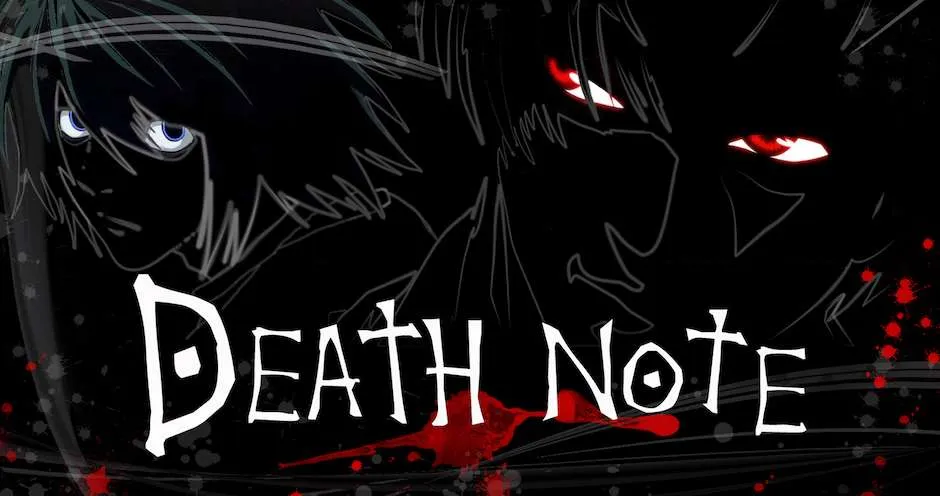
Night is chalked in white scratches and spattered red, a blackboard sky where the city writes its lies. I used to read it like a student—patient, obedient, certain that answers lived at the back of the book. Now I’m the one scribbling in the margins, the ink too dark, the letters too sharp. Every stroke bites through the paper and into the world.

Two gazes divide the dark: one cold as rain on glass, the other hot enough to cauterize a conscience. Between them hangs a thin line—the kind you draw under a name when you mean it. I hold a ledger that shouldn’t exist, a book that promises endings to those who believe they deserve them, and to those who don’t. Each name I write is a step off the curb, a slip from the railing, a whisper that unhooks me from the ledge of who I was.

I’m falling, not through air but through choices, past the last soft excuse into the hard wind of consequence. Down here the city looks honest, stripped to bones and neon, and my shadow stretches long enough to cover graves I can’t see. Somewhere above, the watcher counts my breaths, the hunter measures my steps, and the page waits for a final line that curls like a hook: my own name. If I land, it will be where the red smears into truth—and where every light, blue or burning, turns to look away.

Hogwarts

Hogwarts: A Tale of Shadows and Light

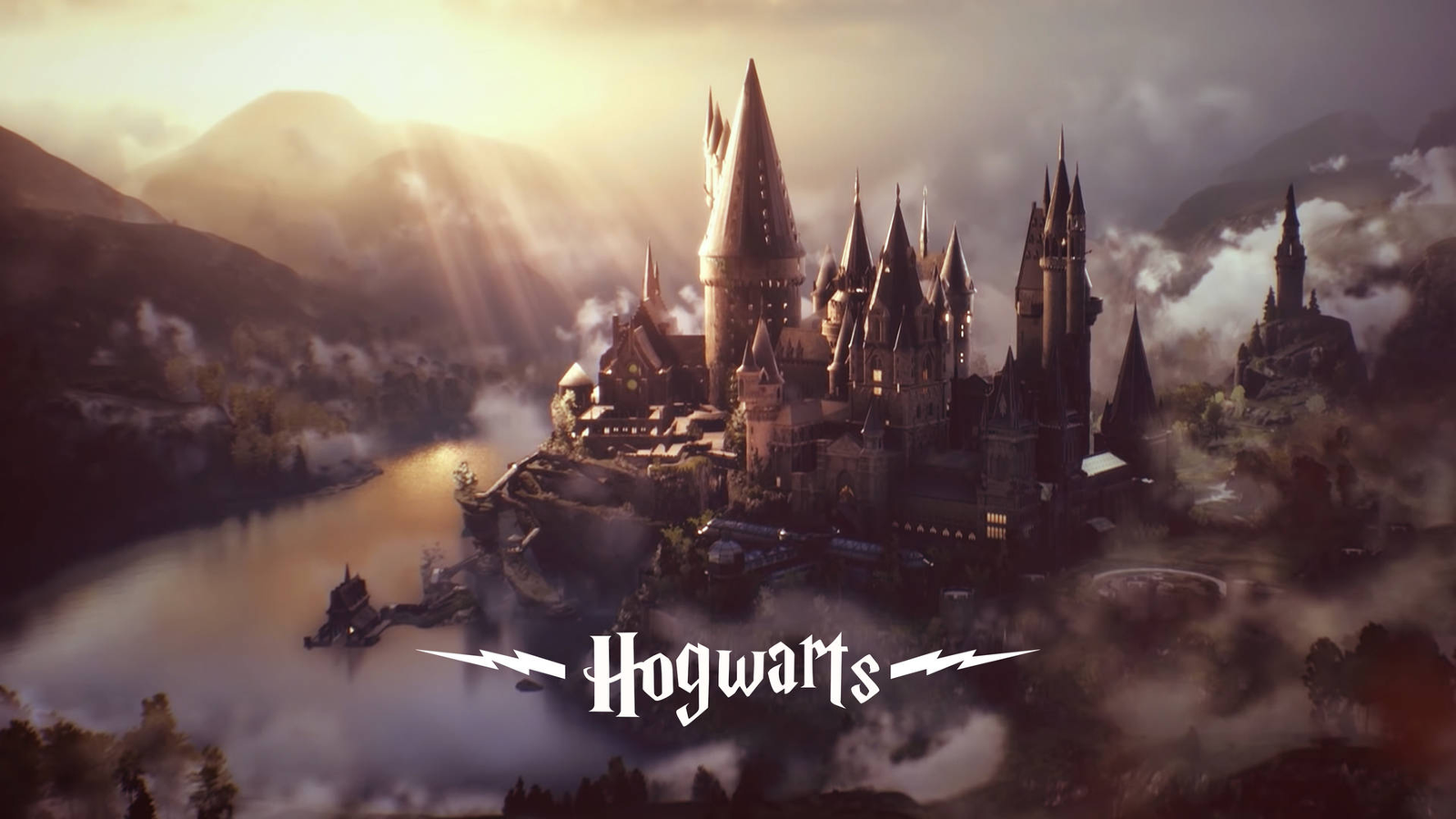
As dawn crested over the distant mountains, its first rays illuminated a sprawling castle nestled atop a craggy cliff, surrounded by the murmur of misty forests and the shimmering expanse of a serene lake beneath. This was Hogwarts, not just a school, but a living entity soaked in arcane energy and ancient secrets. Despite its age-old stones and timeworn turrets silhouetted against the awakening sky, a restless aura whispered through the corridors, hinting at changes borne on the wind.

This morning was unlike any other; the castle seemed to stir from slumber with a sense of anticipation. Inside, its halls echoed with the fading footsteps of ghosts recounting tales of valor and treachery. The Great Hall’s enchanted ceiling flickered with the soft gold of dawn, casting light upon faces filled with youthful eagerness and the wisdom of the aged. Hogwarts was ready once more to welcome a new troop of students, each bearing the potential to either uphold or challenge the delicate balance of magic and mystery within its walls.

Here, amongst enchanted staircases and hidden passageways, alliances would be forged under the watchful gaze of portraits who had seen eras rise and fall. In this sanctum of scholarly pursuit and clandestine intrigue, the young wizards and witches were to discover their true strengths. However, unbeknownst to them, a darker story was about to unfold—a tale that would test their loyalties and courage not just to each other, but to the very ethos of Hogwarts itself.

As the gates opened to admit the throng of new lives, each step they took was a note in the symphony of a deeper magic, one that could either harmonize with the light or dance dangerously close to the shadows. The choice was theirs, and the echoes of their decisions would resonate through the enchanted walls of Hogwarts forever.

The last oni's promise

The last oni's promise

Night burned like a torn banner over the small town, and four shadows in make-believe mail stood at the edge of real fire. A wizard’s hat stitched with a crooked star, a crown of twigs and winter berries, a creaking helm with a red plume, and a healer’s ribboned wand—costumes that were supposed to turn sidewalks into kingdoms—now faced storefronts coughing sparks into the sky. Their wooden staves and plastic swords threw long, brave silhouettes across the blacktop, while somewhere behind the roar of flames, a fifth presence breathed through the smoke, older than sirens and older than the street’s cracked name.

They had called it a game for so long that the town believed them, and belief is the thinnest lock a door can have. The last oni slipped through that door wearing a story for a mask. It spoke without sound, threading its vow through the soot: keep the circle unbroken, speak truth when it is hardest, guard the smallest flame. In return, it would hold the night back by the width of a child’s palm and teach their bright, pretend sigils to bite like iron. A promise is a bridge; it is also a mouth. The oni’s promised hunger was simple—let them stand together, or it would swallow their names and leave the streets to ash and echo.

Dawn waited somewhere beyond the smoke, thin and patient, counting the steps they would take past melted signs and fallen wires, counting the places where chalk maps had once been bright. If they kept the vow, their legend would remain a legend: the last oni would fold itself into a bedtime whisper and become nothing more than the weight of a story in a warm room. If they failed, the door would swing wide and never close again. So they set their feet in the cinders, lifted make-believe like a shield, and walked toward the first trial, where promises learn whether they are bridges—or mouths.

Genesis
Neon blade exorcist

Neon blade exorcist

The city hums like a cathedral of static, its steeples made of rain-slick glass and billboard fire. On a rooftop altar of tar and rusted vents, a hooded figure bows, eyes shut, freckles dusted with ash, a thin ribbon of blood threading from brow to lip. Their cloak carries a constellation of hammered discs—sorrow mirrors, polished by old prayers—each one holding the tremor of a banished thing. Beneath the cloth, a sheathed line of light waits: a blade that sleeps until the dark remembers its own name.

They were sworn where incense met engine oil, initiated in ruins that smelled of ozone and sanctity. The order soldered runes to copper and sutured saints to circuits; it taught that the dead cling to heat and habit, that grief is a network, and that a sword can be folded from colors you cannot see until they cut you. Each exorcism exacted a toll—memories paid like coins into a well without echo—and the discs on the cloak rang hollow after each victory, as if the metal had learned to mourn.

Tonight the wardline falters. A blackout peels back the skin of the district, and something vast breathes through the gap, fogging the neon with a pulse older than thunder. The exorcist lifts their face, tastes copper, and lets the blade bloom: a radiance like a choir of broken glass, humming in the bones. They descend the ladder into the light-drowned streets not for glory, but for a single name they refuse to forget—and for the promise that in a world of ghosts, one cut of living color can still make the night step back.

Black halo protocol

Black halo protocol

The sky opened like a bruise at dawn, violet fading to gold while slow snow flickered in the air like static. Between the pale pillars of light stood a solitary figure in a torn, white mantle, the seams stitched with tired violets, a spear of jagged steel chained to her shoulder as if it might otherwise float away. She carried the case of black ribs across her back and the wind sang through its grooves. Far behind her, the world held its breath; ahead, the horizon glowed with the hush of something vast preparing to wake.

They called it the Black Halo: not a crown but an absence—an engineered eclipse that erased the names of storms and the memories they rode in on. It was a last-resort instruction set buried beneath the old cities, a ritual disguised as a failsafe, a protocol for when truth itself became a weapon. She had been taught the steps in whispers and winter: anchor the spear, speak the cipher, accept the cost. The cost was always written in small letters where the frost bit deepest.

She paused, gloved hand hovering above the chain, and imagined the ring closing overhead, swallowing every unfinished story until only silence remained. The pillars pulsed once, answering some invisible signal, and the snow began to fall in straight lines. If she turned back now, the day would keep its color; if she moved forward, the world would survive without remembering why. She chose the road of light and shadow, and the halo—patient, hungry—tilted to meet her.

Zero divine

Zero divine

At the edge of a sunlit ruin where ivy stitched shadow to stone, she watched the sea lay its turquoise quilt against the shore. The cathedral on stilts stood like a stranded ship, windows hollow, ribs of old faith showing through. Beyond it, sailboats cut white commas in the water, and above everything a second city ghosted the sky—spires and streets printed faintly into the blue like a memory refusing to fade. A dragonfly balanced on a split post beside her, as if even the smallest wings knew how to hold their place in a world that had stopped believing.

They called this era the Quiet Tide, when prayers returned unopened and instruments of augury read the same unblinking value: zero divine. She kept such an instrument tucked under her collarbone, a red cord marking the last promise she’d made to a vanishing heaven. Each morning the needle settled at the bottom of its compass, and each morning she wondered if absence could be mapped the way sailors map wind—by what it leaves behind. The cathedral had been the loudest house of the sea, yet its bells had rusted into silence; even their echoes seemed to have emigrated upward, becoming the faint city etched in cloud.

When the tide rolled in and turned the beach to a mirror, she rose, sand whispering from her hands like grain from an hourglass too patient to lie. There are numbers you inherit and numbers you invent, and she understood that someone must draw the first line from nothing to possible. She would cross to the stilted nave, step into the ribcage of the old world, and test whether zero is a grave or a seed—for the sky-city above, for the water below, and for whatever waits when silence finally speaks.

Rewoven fate

Rewoven fate

The night split like cloth under a tired needle, and the city sagged from its seams. I found her on the brink where spires collapsed into cinders, laughing into the storm as feathers of soot and light drifted about her. Each ember sketched a new contour across the dark, as if the world were a pattern waiting to be cut again.

She wore a crown of iron filigree and a dress stitched from midnight, eyes burning like stubborn coals that refuse to darken. Between her hands shimmered threads I could not name—filaments that tugged at memory, at weather, at the hidden grammar that keeps a day from falling apart. With a gesture, rubble reconsidered its shape; with a smile, a river forgot its course. The loom of destiny was broken, she said, and the only way to mend it was to pull more strands free.

I should have run, but her voice snagged on the frayed hem of my courage. Choose, she told me, be the needle or be the thread. So I stepped into the snow of feathers and sparks, and the city tilted, listening. If we must inherit a torn world, then let us stitch with fire—until fate, unraveled and rewound, remembers a future that fits.

Moonfall Requiem

Moonfall Requiem

At the rim of a wind-scoured night, the Gloamspire rose like a frozen scream, its flanks riddled with hollows where embers kept vigil. The moon had cracked weeks ago; now each dusk it sank lower, a pale cathedral unspooling from the sky, dragging with it a tide of sleepless dreams. The air tasted of iron and hymn-smoke. Every stone knew the refrain: when the moon touches earth, old vows awaken.

From the storm’s underwing came the cantor of ruin, armored in shadows, astride a bat-born leviathan whose tongue tested the cold like a diviner’s wand. They circled the tower and listened to its whispers, counting the lit windows like notes on a stave. In those cavernous galleries, monks and war-wrights had once caged comets and bottled night; now only the wind kept the archives, and it sang through organ-pipes of broken buttress and bone.

I have kept watch since the first fracture split the sky, and tonight the music changes. The last measure draws near, and with it a choice that will bind the living to the dead or untune the world into mercy. When the moon falls, someone must answer its song. If you can hear it, follow me to the tower’s heart, and we will decide which note the night will keep.

The shrine beyond time

The shrine beyond time

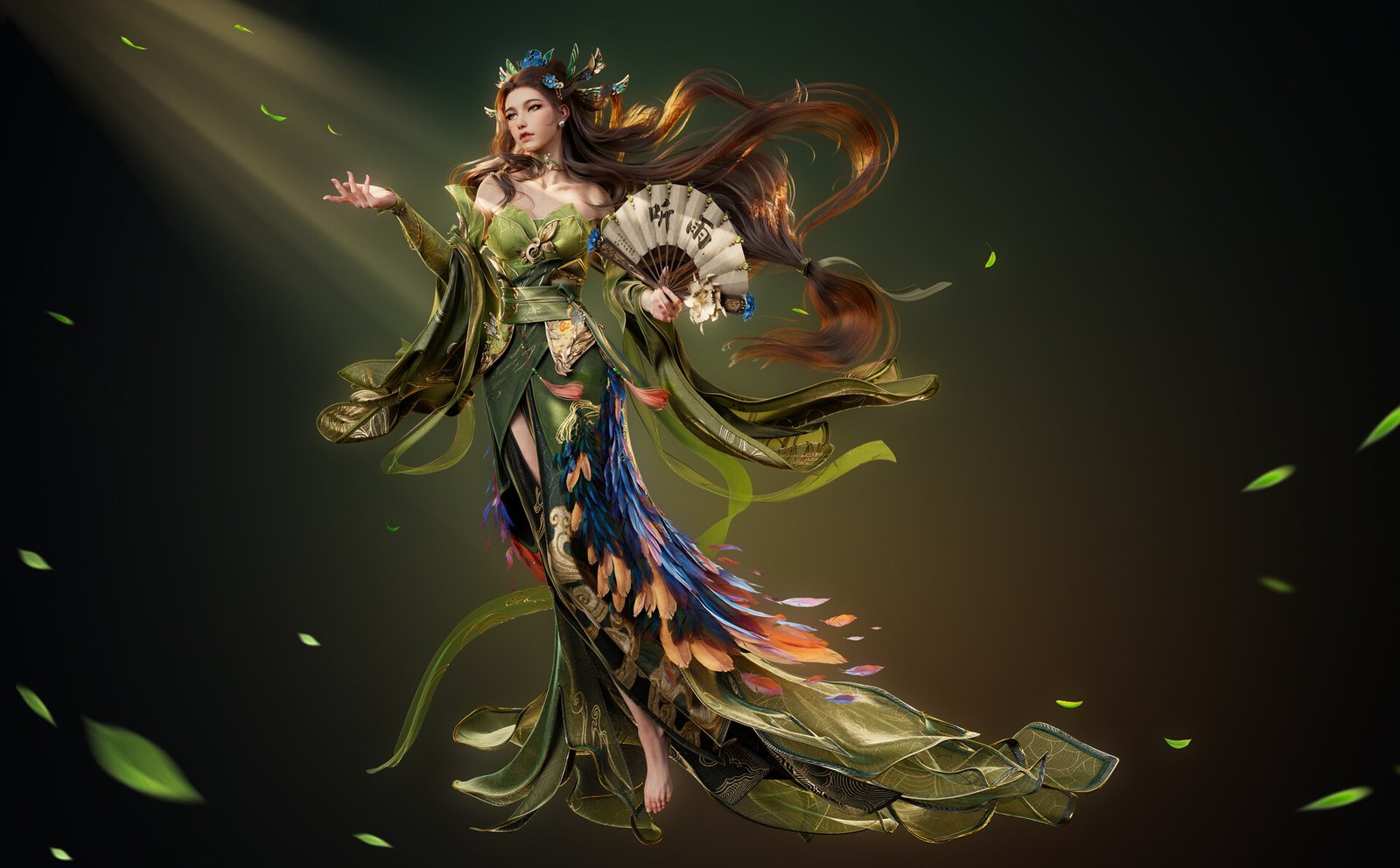
I have walked to the edge of the second hand, where silence pools like oil and the stars seem to hold their breath. There, the shrine waits—a lattice of ages folded into a single breath, its gates breathing a pale, verdant light. She stands before it like a vow made steel: lacquered plates traced with circuitry, a ribbon of green fire drifting from her helm, and a fan of bladed leaves that whisper when they open. Priestess and machine, relic and rumor, she is the only thing that moves when the world forgets to.

They say the shrine was built by the first artisans of tomorrow, or the last survivors of yesterday; that its floor is tiled with years no one lived and doors that open to undone choices. The guardian does not speak at first. She lets the glow at her ankles halo the dark, lets the etched fan close with the certainty of a clock completing its measure. Her eyes do not judge—only weigh. In their reflection I see the debts I carry: names left unspoken, histories edited by fear, the bright wreckage of what might have been.

When she turns, the gates breathe wider. Time loosens, a sleeve unraveling thread by luminous thread, and the shrine sounds like rain on a roof I have not yet built. I am invited, or condemned—it is the same word here. Step lightly, say the rings of light around her feet. Pay truly, say the patterns on her blades. If I pass beneath this arch, the story will not wait for me to be ready; it will begin, and it will ask for everything.

Whispers of the starbound

Whispers of the starbound

On a night washed in indigo, beneath a crescent that shaved a blade of light from the clouds, she stood at the brink where wind met void. Braids threaded with cold glimmer lifted as if the heavens were breathing her name, and ribbons—red as a remembered dawn—streamed from her sleeves. The moon etched her into a rumor the dark had tried to forget.

The starbound do not speak with mouths; they murmur through the tilt of constellations and the ache between heartbeats. She had chased those thin, bright voices from dream to waking—through cities of ash and forests of glass—until they braided themselves above her now, a hush stitched into storm-blue cloud. Come, they said without saying, and even the night, patient and vast, leaned in to listen.

Shadows unspooled around her ankles, old promises loosening their knots. If she reached upward, she could pluck a path from the sky, a river of glow where every star demanded a tithe: a memory, a name, a breath. She steadied herself, closed her eyes, let the smallest whisper pass through her—the one that sounded like home and departure both—and stepped toward the blue-lit break in the world.

The girl who borrowed tomorr

The girl who borrowed tomorr

At the hour when roofs were ink and lanterns were small, patient moons, a girl stood beneath a paper parasol and let the world turn around the spokes. The silk burned with a hidden dawn, a red bloom trapped just behind her, as if the sun had been convinced to wait. Wind threaded her hair like quiet handwriting, and the street gave back only the hush of her sandals, careful as promises.

They say she walked into the market of hours and bartered for a day that hadn’t happened yet. What she received was not a whole tomorrow, but a tomorr—two letters missing, two hours gone—because even time keeps its change. She folded those absent hours into her umbrella’s ribs, where the light could not escape, and signed her name in a ledger nobody else could see. The cost: a memory not yet made, a laugh she had not laughed, pledged to an unseen collector.

Now the city waits under a sky that refuses to be decided. Interest ticks in the rain, and shadows bend toward her like accountants of dusk. She walks anyway, toward a mistake she intends to unmake, the red glow at her back a coin she can spend only once. If she pays it wisely, morning will arrive complete; if not, the day will end early, and the missing hours will swallow more than letters.

When the moon choose a king

When the moon choose a king

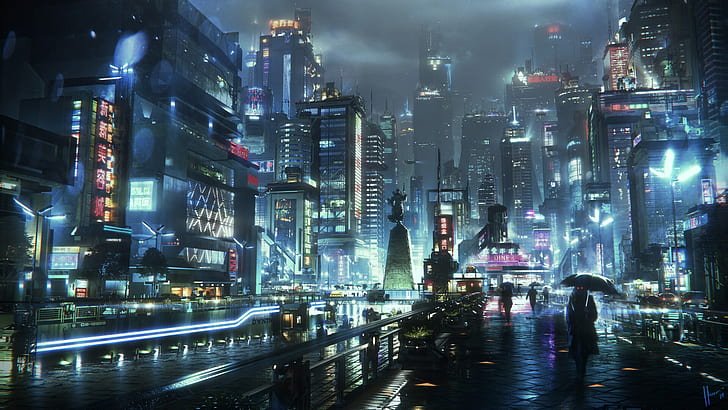
Rain stitched the night into mirrors, every tile of the riverwalk lacquered in neon and skywater. Towers loomed like tuning forks, humming with advertisements and prayer-coded slogans, while a lonely statue on a plinth lifted its bronze question toward the storm. Through the gauze of cloud, the moon pressed a pale thumbprint on the city, and the canals answered with a slow, electric tide, blue veins pulsing along the rails and bridges.

They called it the Choosing—older than crowns, newer than code. Long ago, the moon had been fitted with mirrors and listening machines, its cold light braided with algorithms and auguries. Once in an age of unrest, it sought a sovereign not of land, but of gravity: the one heart that could keep the night from sliding off the world. Screens fell silent to a single white sigil, drones hovered mid-flight, and even the rain seemed to lean in, as if to overhear a secret.

On the promenade, a thin blade of silver parted the wet air and came down where the city breathed the loudest—across cobbles, over the statue’s damp shoulder, and finally upon an umbrella held by a figure who did not move. The crowd felt the tide catch their teeth; lights dimmed, reflections bent toward the chosen shadow. No trumpet, no decree—only the hush of circuits kneeling as the moon steadied its gaze. Somewhere between thunder and heartbeat, the city understood: a crown was descending, woven from weather and code, and the night had decided whom it would obey.

Echoes of a forgetting hero

Echoes of a Forgetting Hero

Arrows stitched the sky while embers fell like orphaned stars, and a lone rider split the blaze. Bronze plates blistered, a diadem flashed with firelight, and the sword in their fist carved open the smoke as if the air itself were a stubborn memory. The world around them shouted a name that would not settle in their chest. The horse beneath them remembered the path; the blade remembered its work. Only the rider, tempered by heat and thunder, had become the blank at the center of legend.

With every charge, something surfaced—river-water cold around a childhood oath, a banner the color of dawn on old steel, a laugh that once turned battlefields into harmless storms—and then the roar of war scoured it all away. The crown bit against the brow like a debt unpaid. Men rallied to the silhouette they thought they knew, but the figure inside the armor rode for a different quarry: the self that fled the moment the fires were first lit.

When the flames finally bent low and the ash began to fall like quiet rain, the echoes did not cease; they grew clearer, arranging themselves into a road of cinders leading past kingdoms and graves, toward the promise that forged a hero and the choice that unmade one. In the hush after the clash, the world waited for a savior’s certainty. What it received was a question carried on a steady breath: Who am I, if not the story told about me? And with that, the embers stirred, and the first step answered back.

Skybound ronin

Skybound ronin

At the rim of the world, where dawn pours molten gold into a miles-deep chasm, a lone blade hums against its scabbard. Above, manta-shapes graze the currents, lantern-bellies catching the sun as if they were ships of a gentler sea. The wind rises from the cleft in the earth like breath from a sleeping god, and the wanderer reads it as one reads a sutra, tracing omens in every eddy and lift. Somewhere behind him, a quiet silhouette lingers, witness or shadow, while the sky-creatures wheel to the rhythm of a tide no ocean knows.

He once wore a crest and answered to a bell that tolled from cloud-temples, when the sky had masters and the masters wrote their names on chains. Now the crest is buried and only the wind claims him. Exiled from the Aerial Courts, he learned to listen to the manta’s songs and the creak of invisible rigging stretched between peaks, to the rumor of islands unmoored and a city that fell upward before it fell away. The blade at his hip is not for glory but for severing the last knots that bind the world to its old fear.

The sun climbs, the canyon breathes, and the leviathans of morning drift nearer, curious as monks at a market. The ronin steps to the edge, feeling the pull of sky as a tide beneath his soles, and he offers the wind a vow it can carry without breaking: to follow whatever current leads to the hidden hand that tethers the heavens. When the nearest manta dips its wing and the air becomes a bridge, he moves as if onto a road he has walked all his life, a pilgrim of the high places, skybound and nameless, with only the horizon to answer for him.

Guardians in training

Guardians in training

The sun rose like a crown above the planet, pouring silver fire across the academy’s orbital ring. Below, oceans turned and continents breathed; above, a fledgling patrol craft slipped from its berth, thrusters whispering, hull etched with the promise of duty. On the observation deck, a dozen cadets stood shoulder to shoulder, watching the distance gather them into its wide, unblinking gaze.

They had learned to read starfields as if they were scriptures—routes and refractions, codes of contact and the physics of mercy. Guardians, not conquerors: the oath had been spoken in quiet halls and loud hearts, a vow to keep the lanes open and the night honest. Today would be the first crossing without a safety net, a simple circuit to the outer beacons, a ritual they called the Warden’s Run.

But beginnings have a way of testing the name you give them. In the glare behind the star, the sensors found a ripple with no orbit, a thin seam where gravity forgot itself. The instructors called it a curiosity; the cadets felt it as a summons. As the ship tilted toward the light and the station released its hold, they stepped from lessons into legend—unsteady, unproven, and already necessary.

Blood ink contract

Blood ink contract

The jungle breathed in shades of sea-glass and rot when she knelt upon the strangleroot and opened her palm. The script she traced did not lie flat—it writhed, a living scrawl that drank from her and from the waiting maw beside her. Antlers crowned her helm, thorns of hammered gold; at her hip a bow hummed with a witch-light string. The panther-shadow at her flank blinked embers, and together they signed the only treaty the wild will honor: hunger bound to purpose, hunter bound to cost.

They called it blood ink because once it dries it cannot be washed, only answered. Each name written becomes a clause, each clause a chain tugging at two hearts. With every arrow she looses, a line etches along her bones; with every throat the beast closes, another rune glows beneath its hide. Their contract promised the unmaking of treachery—those who traded lives like coin, those who burned oaths for warmth—yet it also promised payment, and the debtors were not only the guilty.

Tonight the first clause awakens. Green fire gathers on the bow’s curve, and the beast tastes a scent like old vellum and cold iron—the odor of a scribe who learned to forge fate. Somewhere ahead, beneath lianas and ruined sigils, lies the ledger that started a war. The blood has already written their path; the only question left is whose name the ink will finish last.

Chronicles of the last blade

Chronicles of the last blade

The sky had the color of cooled iron, and the earth rang like a bell struck too often. Empires had spent their last prayers here, smudged into the mud with the bootprints of men who forgot their own banners. In that hush before the charge, something older than kings opened its single, patient eye—a blade forged when the world still learned its first words. It remembers only endings. It turns only when an age is about to run out.

Across the ruinous field, a slight figure rose on the recoil of broken ground, hair whipping, steel drawn in a line that swallowed light. She flew at a mountain in flesh and iron, a warlord hewn from campaigns and scarred oaths, his axe lifted to write another chapter in blood. All around them, ranks faltered, breath misting to silence as the air tightened. When their edges met, the sound did not ring—it sank, a note so low it felt like the world had inhaled and forgotten how to exhale.

Those who survived would swear they saw the sword drink the color from the day, and that the wind turned pages none could see. For the last blade does not choose heroes; it chooses moments that cannot be undone. The first cut of this meeting would be the mark that opens the Chronicle, the final tally of a century’s debts. After this clash, there would be fewer names to speak and more echoes to carry them. And the blade, sated and watchful, would wait for the last story it was forged to keep.

Neon Sakura rebellion

Neon Sakura rebellion

The city taught the blossoms to glow. Filaments laced their veins, and every petal pulsed with corporate scripture, a lantern-lit net cast over alleys and temples alike. Yet at the edge where concrete thins to roots, a lone figure stood beneath the branches, the world around him washed in ash-gray while a single ember of blue burned in his gaze. He gripped the worn tsuka, listening to the hush between heartbeats where old vows sleep and new wars breathe.

The trees whispered telemetry—names, debts, betrayals—until his blade’s quiet rasp cut through the data-scented mist. Scars mapped the story he never told; the city had written too many endings in other people’s blood. Beneath the neon canopy, he traced a memory of spring untouched by power grids, and the edge in his hand remembered how to speak that language. If the regime had turned the sakura into cameras, then the first strike would be a blackout.

When the wind rose, a single petal failed to obey its programming and drifted wild, landing on his knuckles like a dare. He answered by drawing the horizon out of its sheath. Somewhere deep in the circuitry of night, alarms searched for a culprit and found a ghost. By dawn, rumor would name it treason; he named it a beginning. The blossoms would keep shining, but from this hour their light belonged to the uprising.