

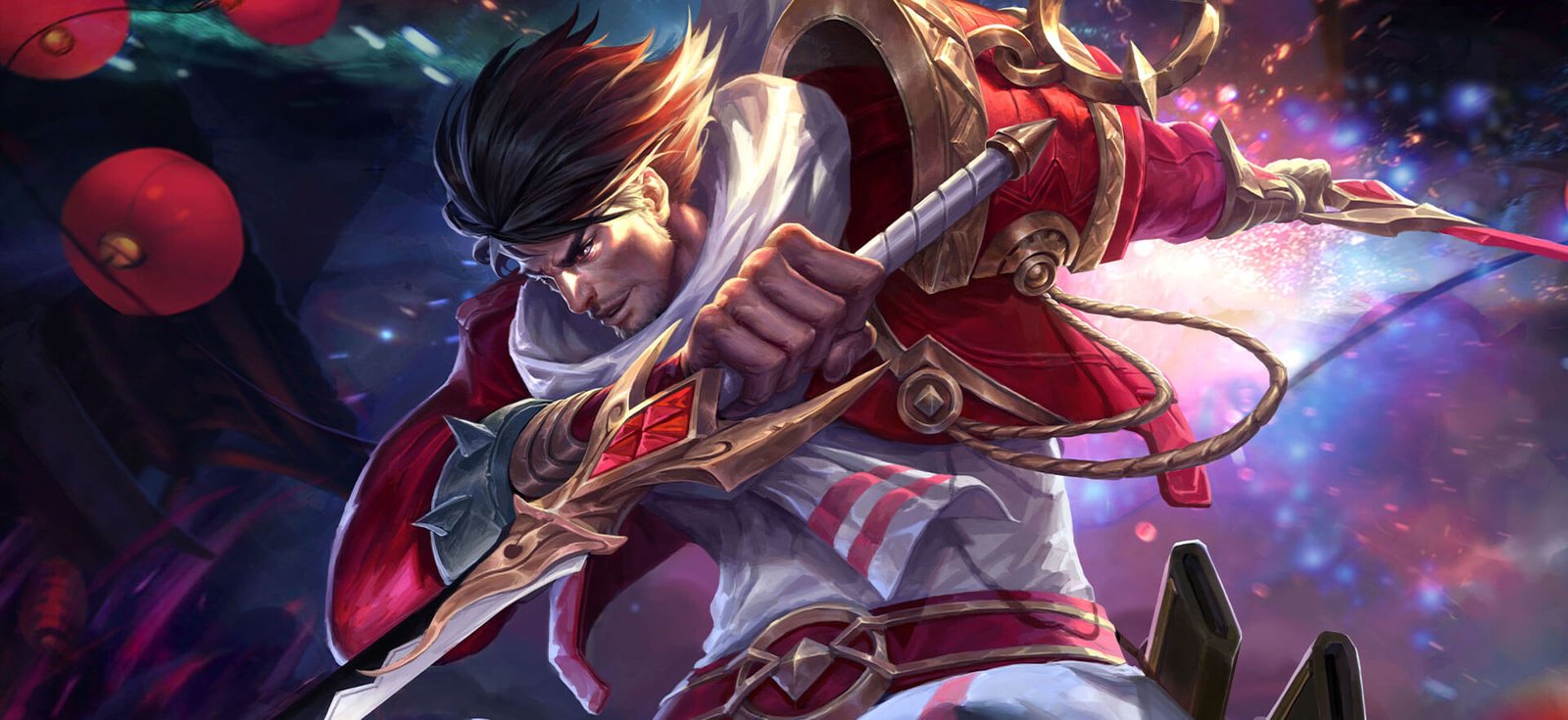
End of a gruesome
Lanterns swung like patient moons over a street that had forgotten how to sleep. Ash from spent fireworks drifted in slow constellations, and through them moved a figure in crimson and ivory, a spear balanced across his shoulders like a promise he could not put down. Gold circlets hugged his coat and a pale scarf trailed behind, catching sparks as he cut a path through the festival’s afterglow. Someone had painted three words on a banner and left them unfinished—End of a gruesome—then the paint ran out, or the courage did.
He carried both in excess. The spear’s ruby facets held the city’s light like fractured dawn, and every step he took unstitched a little more of the night. Once, he had been hired to hunt monsters; too late, he learned how neatly a human can fit that definition. Now he walked not as an executioner but as an answer, seeking the last echo of a spree that had turned celebration into caution, laughter into locked doors.
The trail led toward the river’s black ribbon, where lanterns thinned and the wind spoke in rope-whispers around the iron rings at his waist. He halted, listening to the quiet between heartbeats, and realized the sentence on that banner was waiting for him to finish it. Mercy would be a word. So would Reckoning. When he lowered the spear and stepped into the darker street, even the ash seemed to hold its breath to hear which one he would choose.
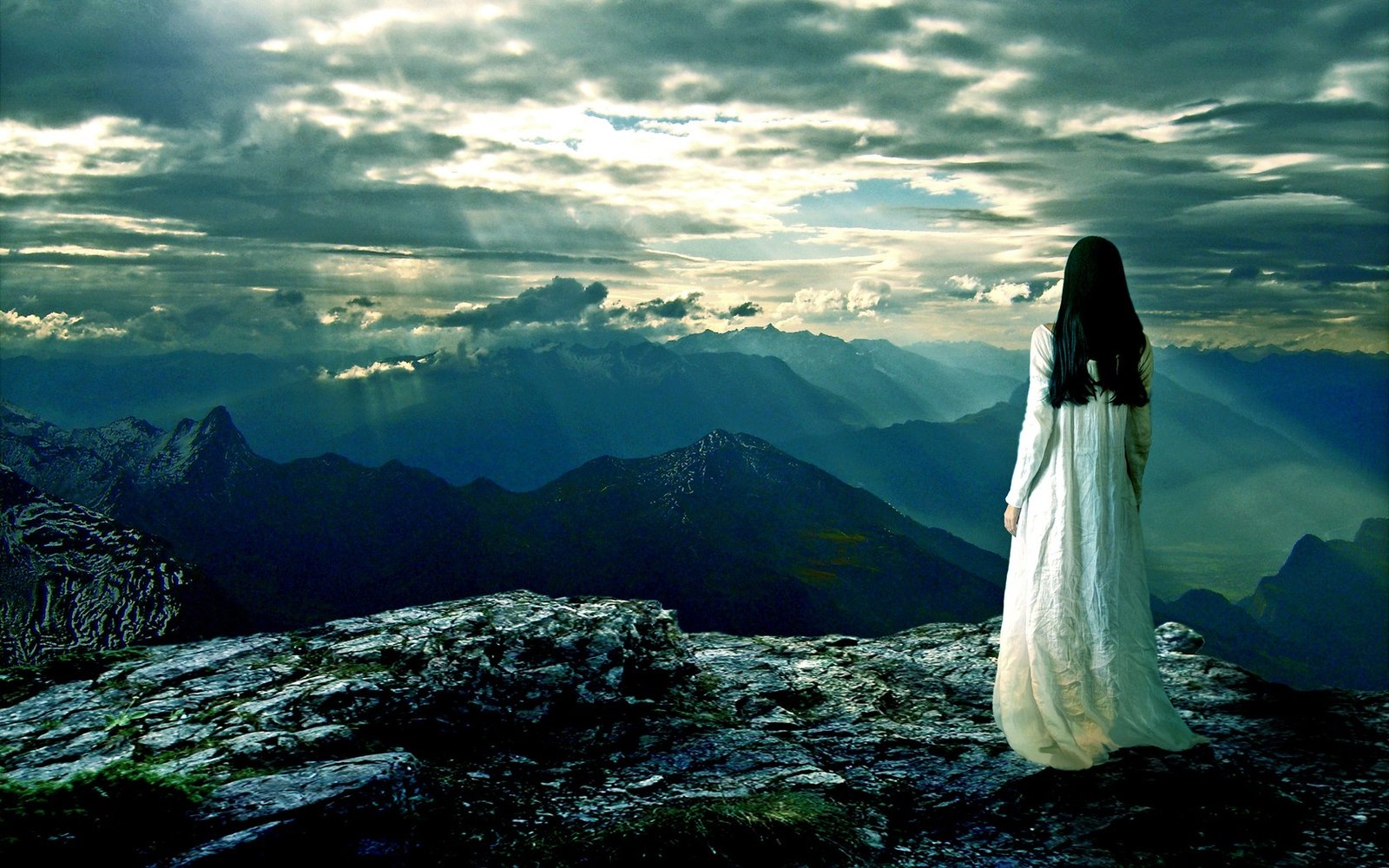
A Cresent of serenity in a c
The sky unstitched itself above the high country, letting down pale ribbons of light that curved like a silver sickle over the darkened ranges. She stood at the cliff’s lip in a dress the color of undisturbed snow, the wind combing her hair while the mountains breathed in blue. Between storm and sun there opened a quiet, a thin bright arc resting on the world—fragile, steady, impossibly calm.
In the journals she carried, one torn line returned again and again: A Cresent of serenity in a c— The ink stopped there, swallowed by a scorch or a hurried hand. A cartographer had written it before vanishing into these peaks, or so the stories said. She had climbed to find where the sentence lives on, to learn whether the missing letter was a place, a danger, or a vow. Below, valleys murmured with the rumor of restless towns; above, the wind wrote softer truths across the clouds.
She would descend when the light finished its curve, when the hush had taught her the shape of her first step. Somewhere in the long shadow of a ridge, the word would complete itself—a cradle, a chasm, a chorus—whatever the world chose to be when she named it. For now, the crescent held, and in its slender mercy she gathered breath, gathered purpose, and stepped toward the story waiting on the other side of the sky’s small blessing.
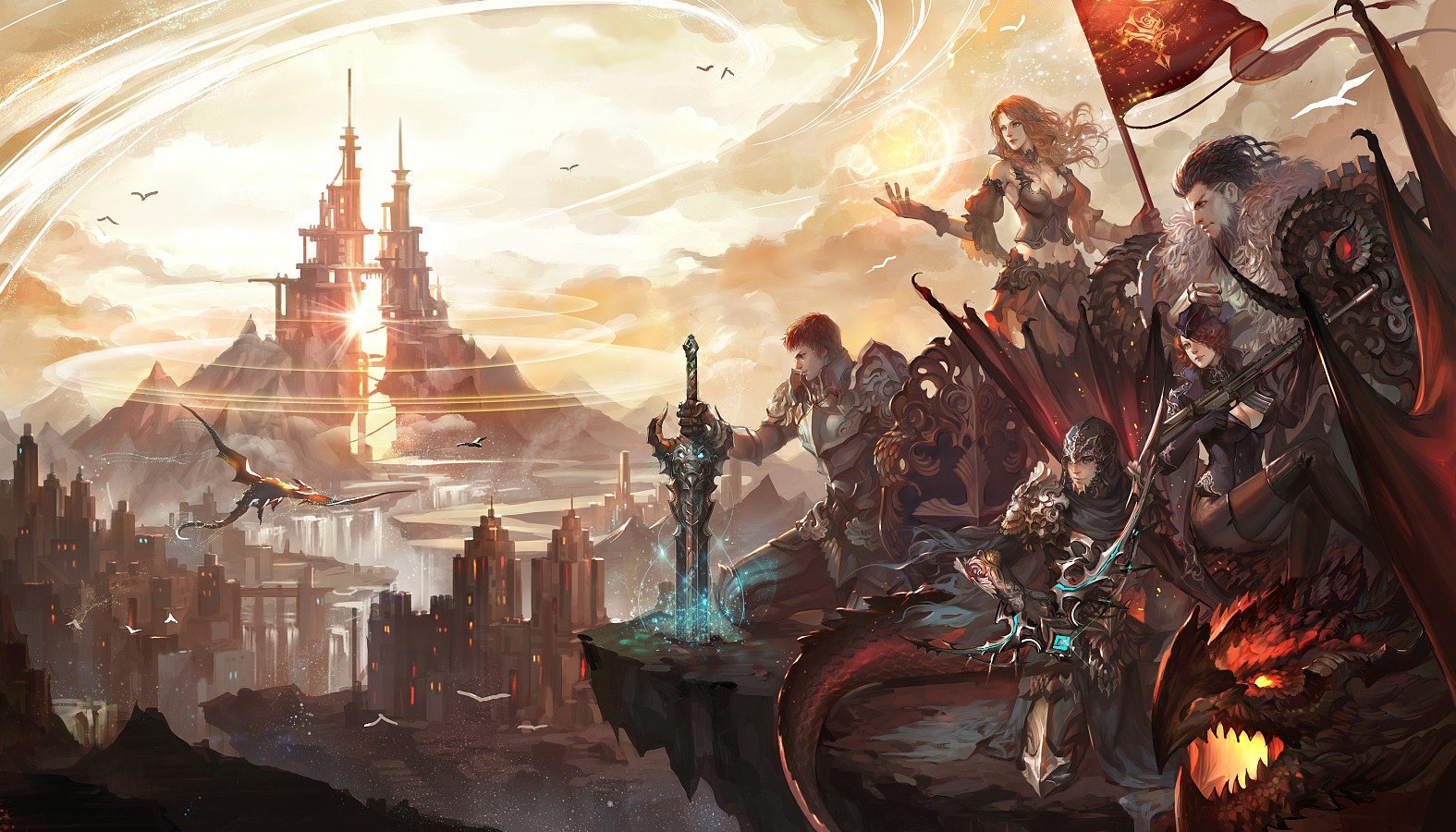
To win a battle
Dawn split itself upon the citadel like a second blade, spilling gold across the ringed ramparts and the drowned avenues below. Dragons stitched the sky with embered arcs, circling the keep whose light never dimmed and whose shadows never stayed. Cities clung to the cliffs like prayers made of stone; waterfalls breathed mist into streets of spire and soot. All of it hummed beneath a lattice of whirling halos—as if the heavens themselves had been wound tight to keep one truth from escaping.
At the edge of the world a knight knelt, setting his sword into black rock until the ground remembered its name. The metal sang—cold stars waking inside the steel—and behind him gathered those who had wagered their futures on its note: a standard-bearer with winter on her shoulders and summer in her eyes, a veiled marksman whose bolts wrote constellations, a dusk-clad rogue cradling a bow bent from thunder, and a red-eyed drake coiled like a smoldering question. Their banner snapped toward the sunlit keep, as if eager to be burned.
They did not come for glory. They came because the halos were a lock and the sword was a key, and every hour the citadel harvested one more heartbeat from the world. To win a battle, they had been taught, is to pay a price the enemy never considered you willing to spend. Before the first charge, before the first wingbeat breaks, the knight breathed a vow into the blade: that the circles would break, that the city would wake, and that if the gate demanded a name to open, it would be his.

Boundaries
From the hush of a starless field, a face rose like an ember refusing to die. Feathers, pale and dark as winter sky, crowned her brow; a single band of red crossed her gaze, an oath painted in silence. She stood in the center of the night the way a cairn stands in an unmarked land—proof that someone has been here, and that someone will return.
There are edges to everything: where wind hands the song to the grass, where a promise becomes a law, where memory hardens into myth. She kept the names of those edges like talismans, beads of story threaded through her hair, listening to the borders between breath and echo. Some lines protect. Some lines imprison. Most are drawn by trembling hands.
Now the old markings blur—maps rewritten by hunger, by fear, by the quiet greed of forgetting. The veil between what is and what was thins until it hums against the skin. She steps forward to redraw the world with careful footsteps, not to sever but to stitch. In the days to come, every choice will be a line: between mercy and flame, between homeland and horizon, between the person she was told to be and the one she dares to become.
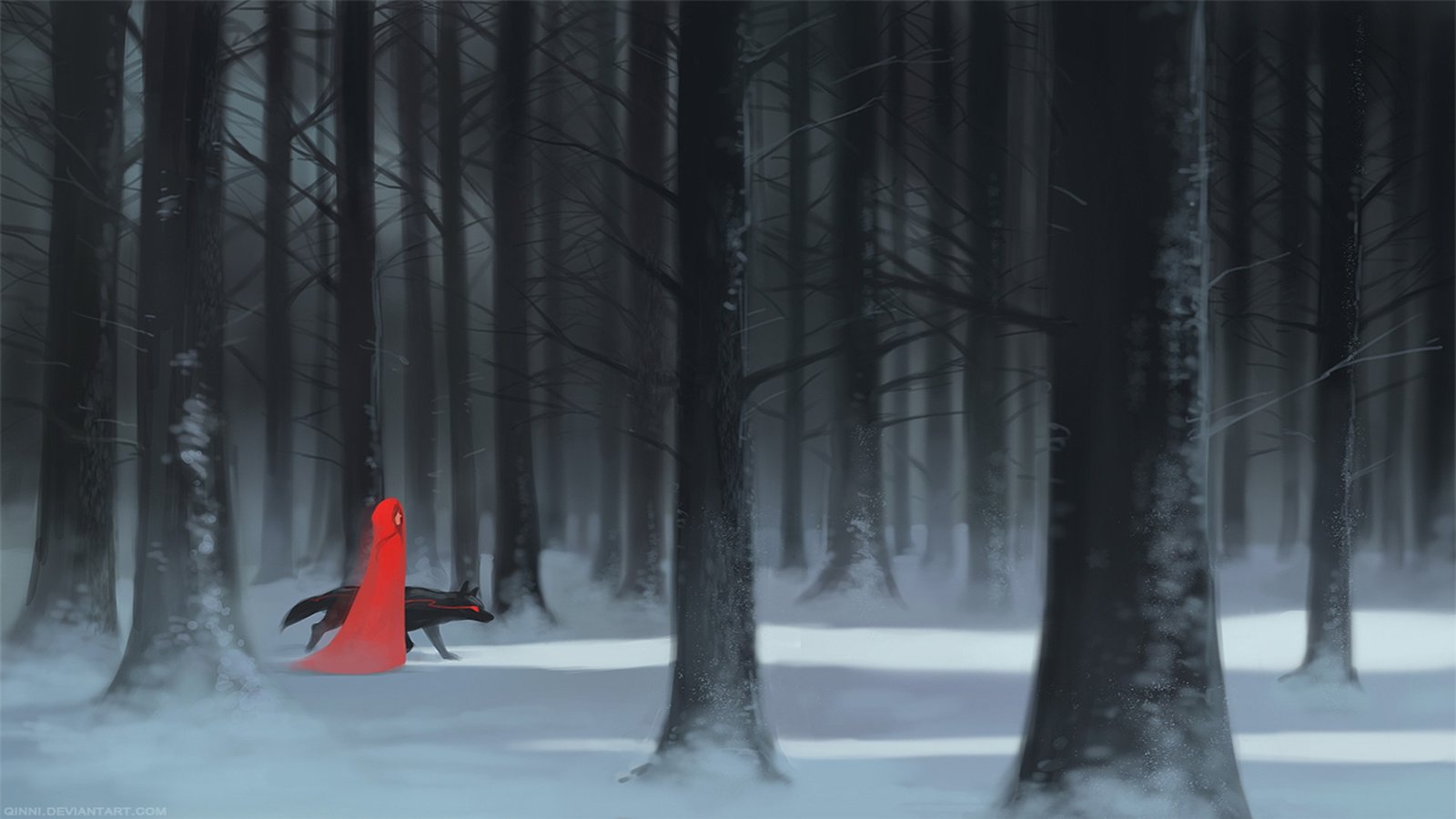
Struggles
The forest holds its breath beneath a pall of snow, a cathedral of black trunks and whispering frost. Through it moves a wound of color, a hood the shade of a fresh cut, trailing a red seam across the white. At her heel pads a dark companion, a wolf stitched from shadow and winter smoke, eyes like coals banked against the cold. Their prints pair and stagger, two beats of a stubborn heart.
She is not lost, not exactly; the world simply refuses to arrange itself into a path. Trees lean in like judges, the wind sifts old names through their needles, and the snow makes promises it cannot keep. The cloak remembers warmth she no longer trusts, the wolf remembers hunger he no longer obeys, and between those memories she threads herself forward, a needle trying to mend what was torn in the night.
Every step bargains with the silence. If she stops, the past will find her. If she runs, the future might. So she walks, a negotiation writ in breath and footprints, learning that strength means carrying fear beside you without leashing it, that mercy is a fire you must feed even when your hands are numb. Somewhere ahead a door is waiting, or a mouth, or a lantern, and the forest will measure her worth by how she chooses to meet it.
Fascinating
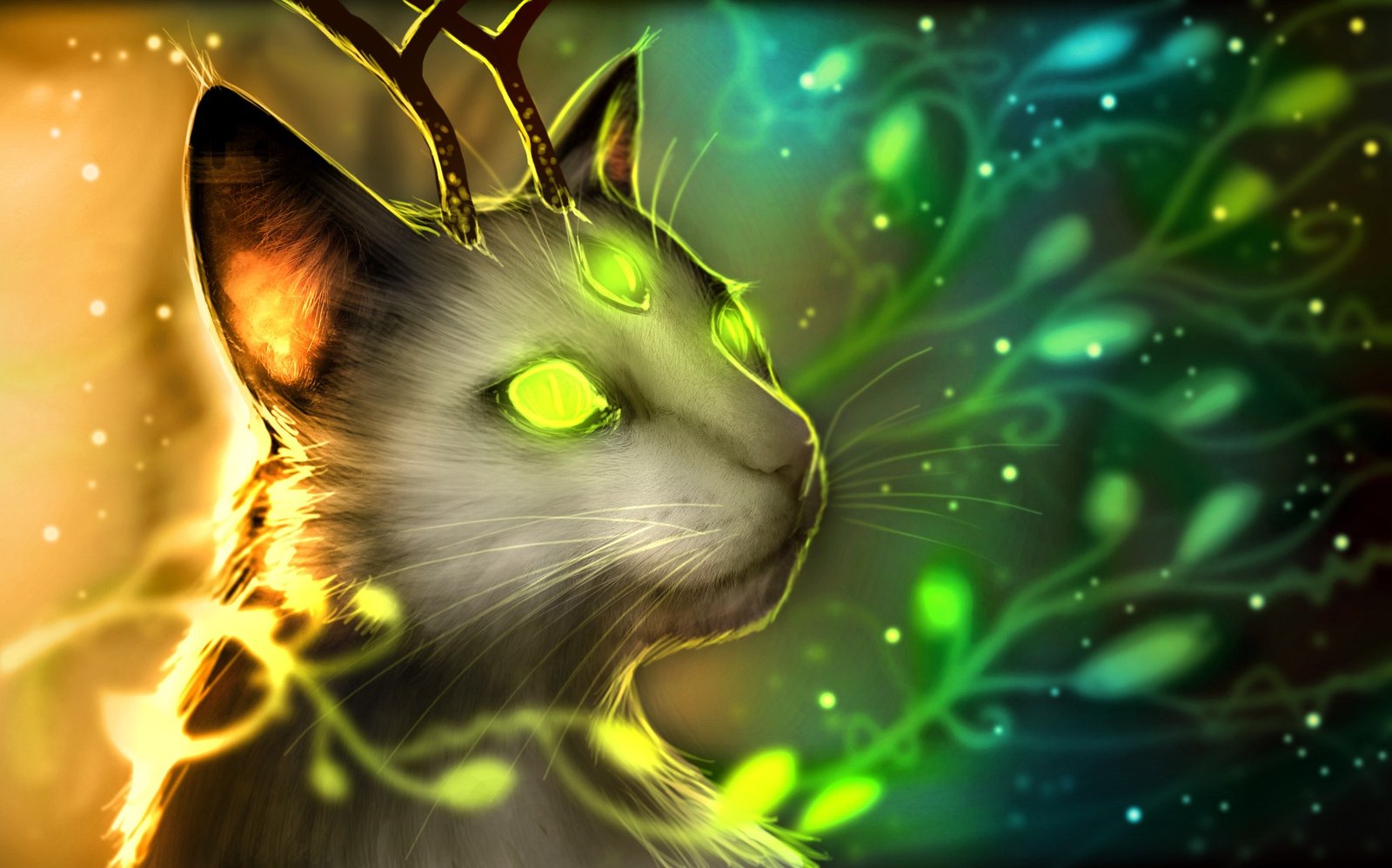
At the seam where dusk trades secrets with dawn, a white cat steps from the hush of leaves, carrying a forest in its gaze. Antlers like twined branches rise from its brow; a third, emerald eye blooms and blinks, scattering motes that drift like seedlings through the air. Vines of light curl around its whiskers, writing sigils on the wind. In that glow the world appears rewritten—paths rethreaded, names unpinned from the things they once belonged to.
I’m told not to stare at wonders, only to catalog them. But this one stares back. The cat tilts its head and the night rearranges—constellations spool into green filaments, mapping not the sky but the choices I’ve avoided. Somewhere, bells ring muted beneath the soil. The word arrives unbidden, whispered by my cautious heart and echoed by the leaves: fascinating. The moment tastes of citrus and rain, of a door cracked open a breath too wide.
The creature pads forward and every step lays roots into time. Its light fingers my shadow, tugging it free of me as though shadows are only promises we forgot to keep. Follow, says the third eye without sound, and I understand that this is not an invitation but a key, pressed warm into my palm. If I go, I will not return with the same name; if I stay, the map will fold and smolder. The cat waits, patient as dawn, while the world holds itself between yes and no, leaf and star, fear and the thrill of what comes next.
Fathom
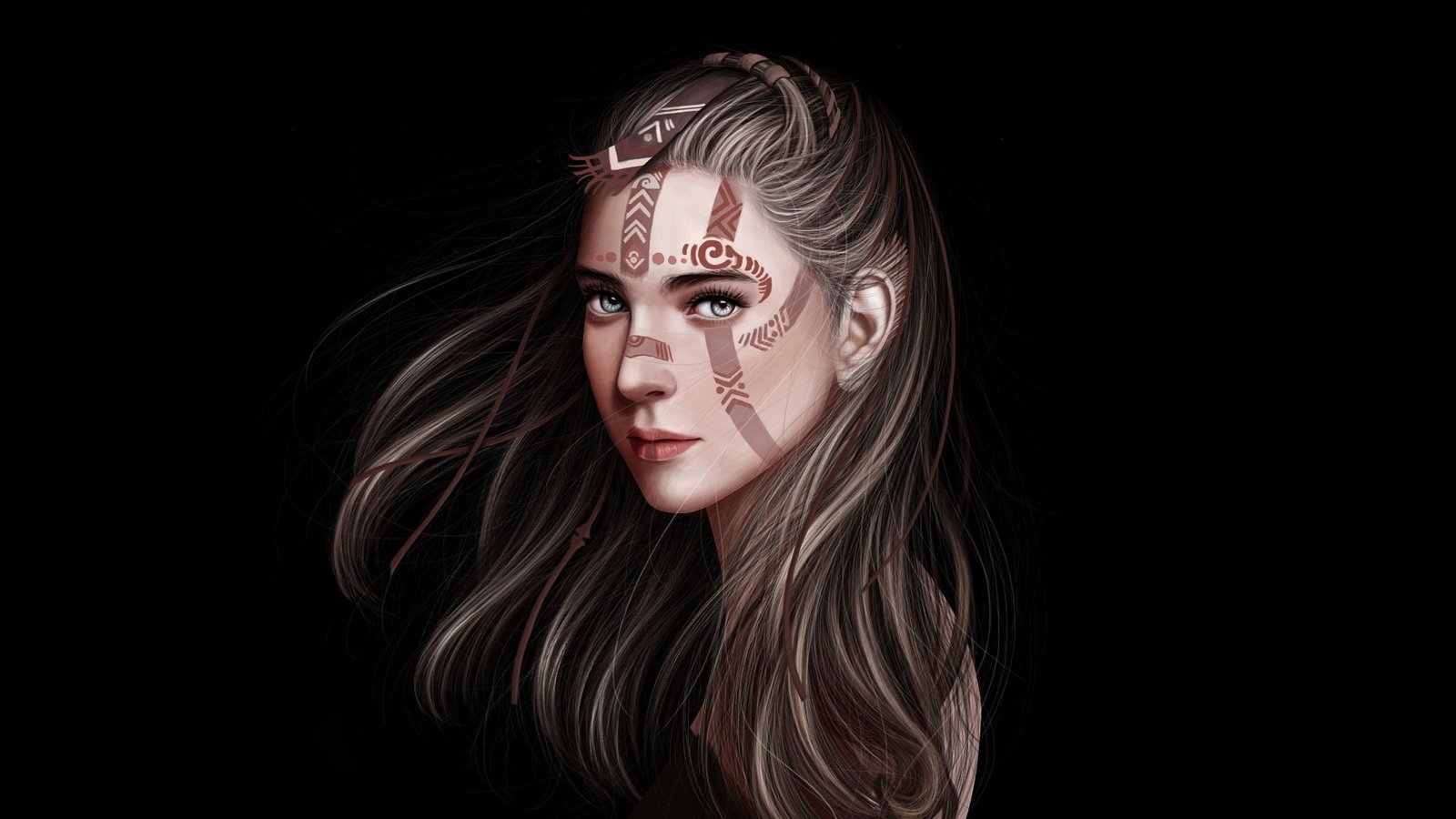
Night pooled like ink at the rim of the world, and she stood where the land frayed into black water. The sigils painted along her brow and cheeks—thin currents, hooked spirals, quiet chevrons—caught the faintest stray light, as if they remembered the sun better than the sky did. Her hair moved as though listening, each strand teased by a wind that rose from the unseen below. In her grey gaze a distant tide turned, patient and old, and the sea answered with a hush that felt like a held breath.
They had marked her young, not for war but for measure. A fathom was an arm’s span, a human reach set against an inhuman depth—a confession that to know the ocean you must place yourself inside the question. The elders etched maps of drowned streets and sleeping trenches upon her skin, a cartography of vows: where to descend, where to return, where never to go. Yet the rules were shore-thin things, and the deep had a voice that braided itself through her thoughts, promising that understanding was not on any chart.
Tonight the voice brought a name that was not a word but a weight, pulled from the trench where memory is kept under pressure. It rose through her like a lantern found intact, burning with something that wasn’t fire. She stepped forward, feeling the boundary slip from ankle to calf, the chill of knowing creeping higher, and every mark on her face seemed to align with some hidden current. The first lesson of depth is surrender, the second is return. She would learn both. To fathom what waited below, she would become the measure and the plunge.
Enslaved
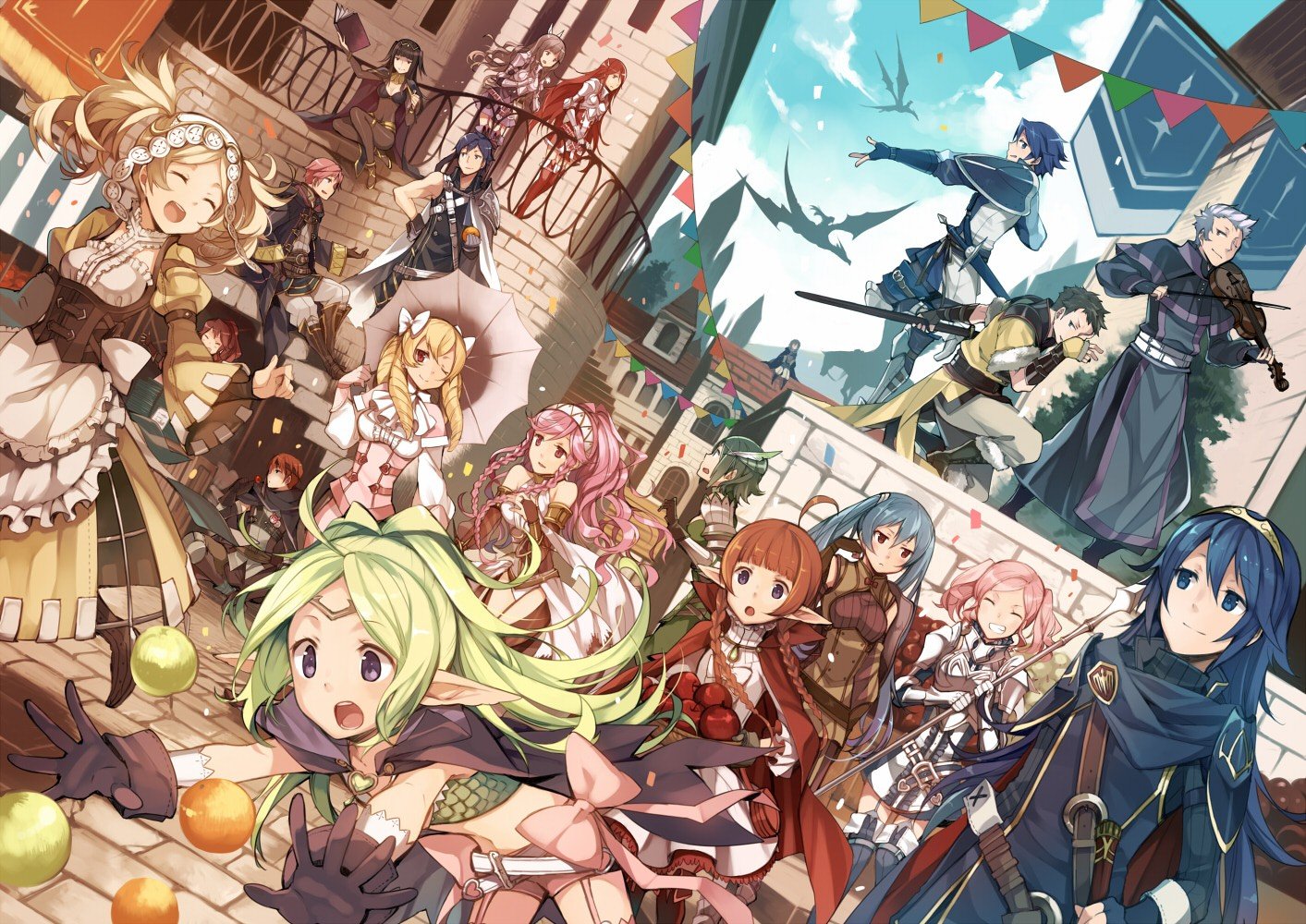
Banners trembled like captured birds above the market, and the music was bright enough to blind. Laughter rolled through the streets with the apples that tumbled from a startled child’s arms, and every smile seemed polished for the parade. Even the shadows kept time: armored figures on the steps, robed readers on balconies, and high in the split-blue sky, silhouettes wheeled like ink stains across a page. The city called it Jubilee, but it was a rehearsal for obedience, a celebration penned by other hands.
Their chains were clever things—stitched into gloves as oaths, braided into hair as customs, hidden beneath cloaks as debts. A swordswoman at the railing measured the horizon as though it were a lock; a violinist drew a bow so carefully you could almost hear a key turn. Merchants counted coins stamped with a foreign crest, and a priest raised a blessing that sounded suspiciously like a contract. No one spoke of the price, though everyone wore it: the mark of safety bought from sky-born wardens, the quiet rule that joy must be loud enough to drown the flutter of fear.
Yet stories slip their knots where noise grows thick. A dropped apple rolled under a soldier’s heel; a page tore loose from a balcony and kissed the cobblestones like a secret finally brave enough to land. In that small stutter the music faltered, and I felt the city inhale for the first time all day. Freedom rarely begins with a banner. It begins when someone notices the weight of a ribbon, and wonders why a festival needs so many ties.
Trapped
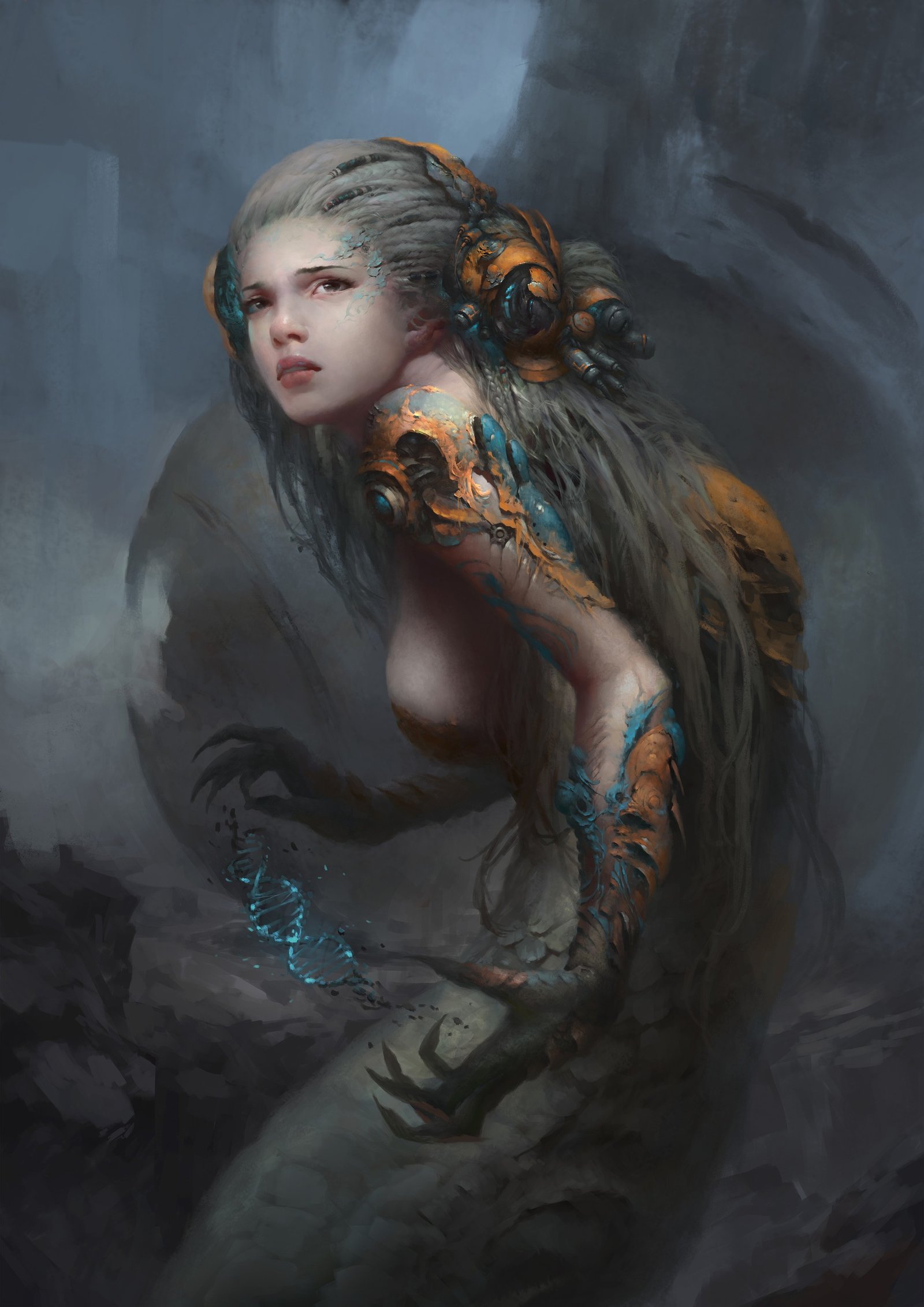
She wakes in a ribcage of stone and rust, where the sea forgot to breathe and left only mist to wander the corridors. The orange husk welded to her shoulder ticks like a wounded tide, a relic of hands that called themselves merciful as they stitched engines to a living girl. Scales whisper against the grit as she moves, and the cavern answers with a hollow echo—one voice speaking to another, both of them her own.
Between her claws a thread of light unwinds—a spiral of blue code, fragile as frost and older than memory. It is a leash disguised as a miracle, the shape of every order that ever decided her, the song her makers taught her cells to hum. She remembers the warm lamps of the lab, the taste of brine and solder, the promise that she would mend a broken world if she first broke herself. The metal blossoming from her skin is beautiful in the way of anchors and cages.
She is trapped in bone, in brass, in the long echo of someone else’s design. But the helix stutters when she breathes against it, and the air stirs with the small courage of dust. If a prison can be studied, it can be mapped; if mapped, perhaps rewound. She curls around the flickering braid of her fate and listens for a weakness, a seam, the infinitesimal moment when a lock remembers it is only a pattern. When it comes, she will be both key and flood.
Heartbroken
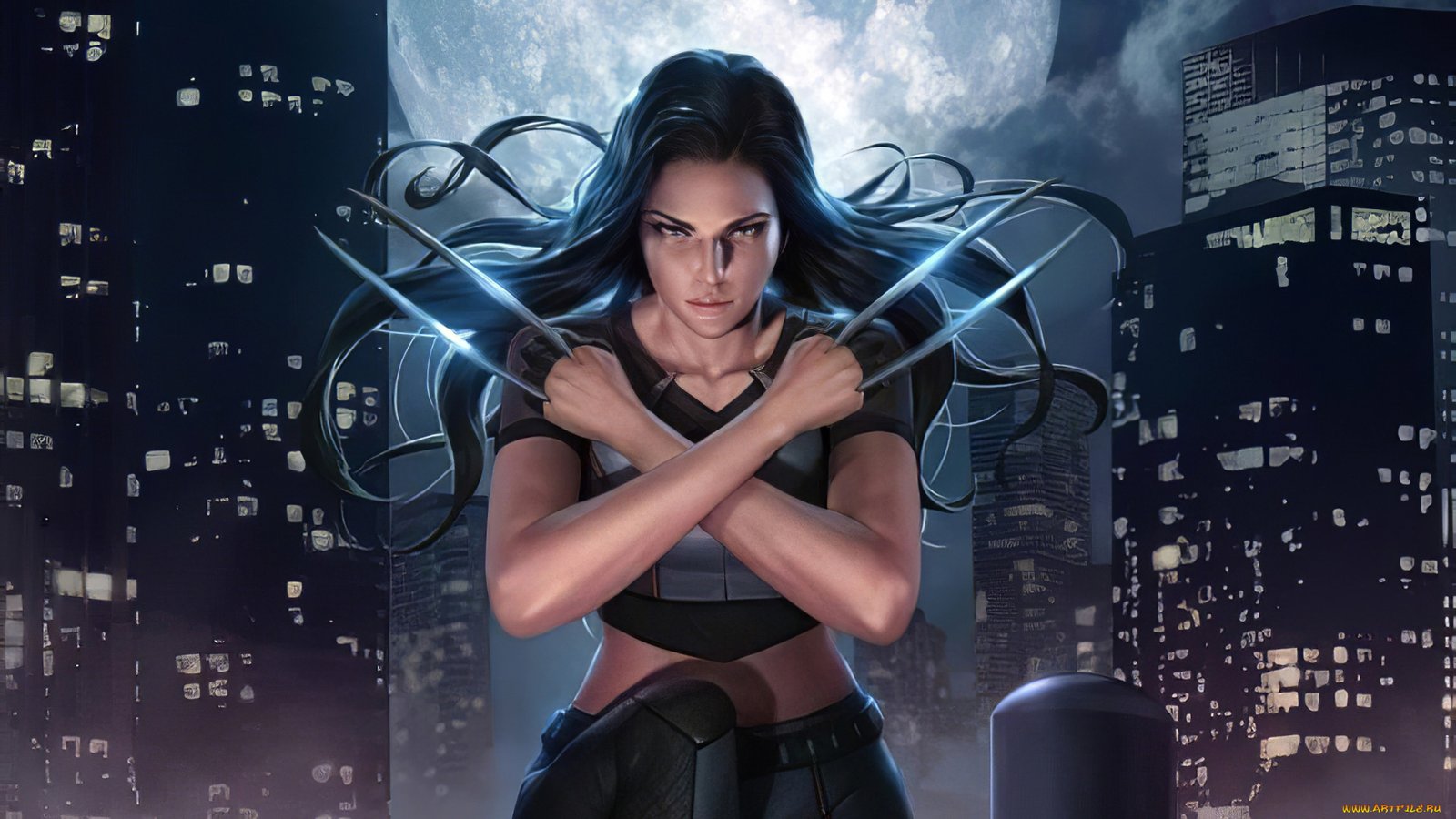
The city hums like a distant wound beneath a swollen moon. On a rooftop of gravel and glass, she kneels, crossing steel over her chest until the metal sings. Wind threads through her hair and the night holds its breath, a thousand windows blinking like watchful eyes. Somewhere below, laughter leaks from bars and lovers make promises; up here, promises are kept with edges.
Once she thought a heart breaks clean, a single crack you can stitch. She learned it splinters—each shard a memory sharpened to a point. The soft voice that said stay; the door that never opened; the message that came too late. She forged them into discipline, into motion, into the click of claws slipping free. Every scar is a map. Every map points to the same place: the truth no one wanted her to find.
She rises, the moon painting her in cold silver. Towers form a canyon around her, and the wind carries the scent of rain and lies. There will be no elegy tonight. Only a hunt, patient and precise, until the city admits what it did. When dawn comes, she will unlace the darkness from her ribs—or carve a new name for grief in the skyline.
Food
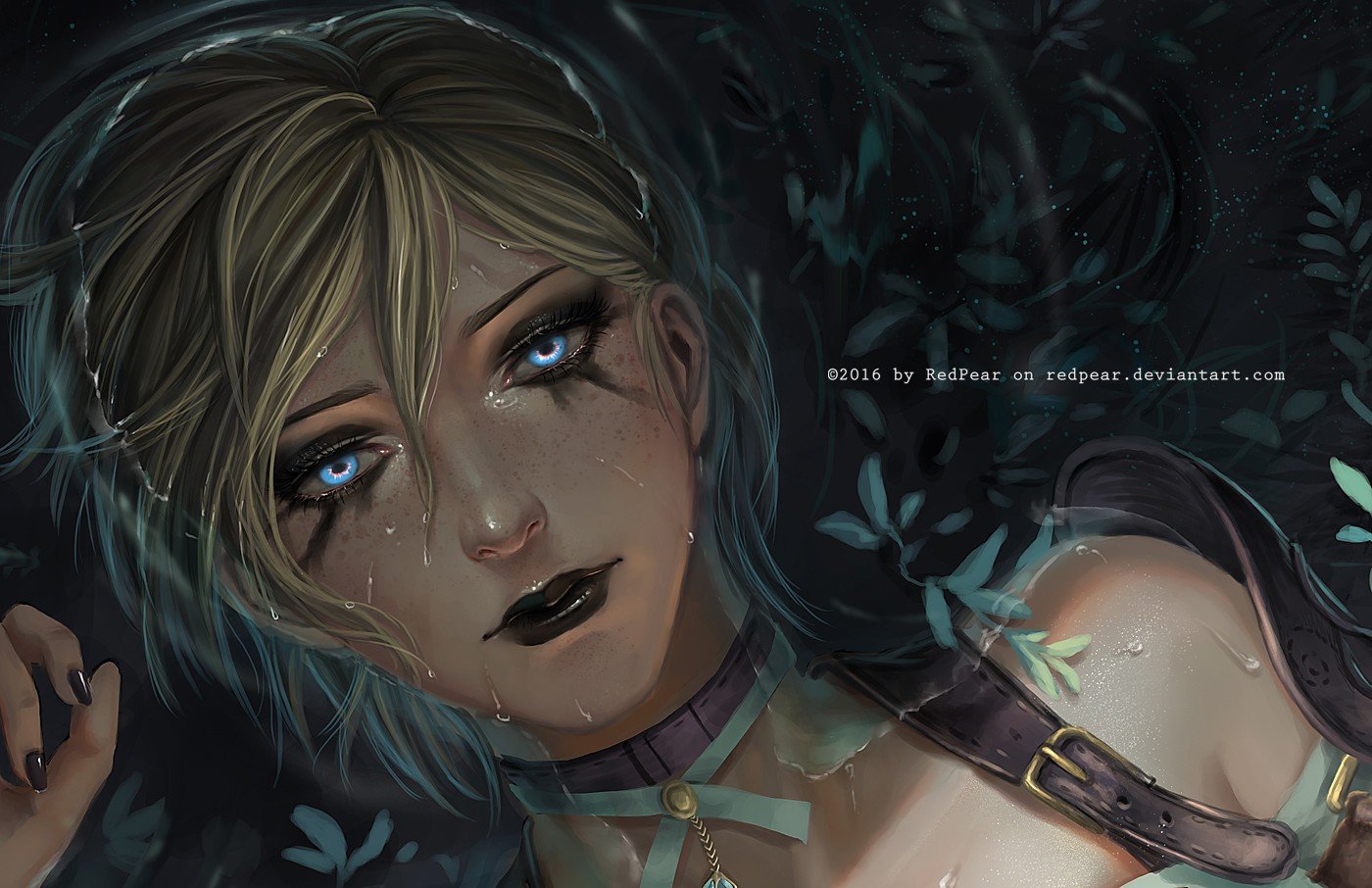
Rain stitched the night into a single, shivering cloth, and she rose through it like a secret surfacing. Leaves clung to her skin; black paint feathered beneath her eyes; a ribbon at her throat trembled with each breath. In the water’s glass her pupils burned an uncanny blue, not light caught, but light hunger—something that had learned to look back at the dark and ask what, not who, it could become.
This city eats everything. It salts its streets with noise and seasons its houses with grief; it chews on names until only rumors remain. People barter in portions—hours for coins, trust for shelter, love for a quieter sleep—and call it living. She knows the recipe by heart, because she was raised to be a course on someone else’s table: a pretty garnish, a soft surrender, a story served warm and gone.
But tonight the water tastes like beginning. The strap across her shoulder is no tether; it is a handle for the life she will carry out of this flood. She will learn the diets of gods and landlords, of kings and clocks, and decide what deserves to starve. And when morning finds her, it will find a kitchen in the shape of a girl, setting her flame to the world’s old hunger and cooking something new from the ruins of its appetite.
Faith
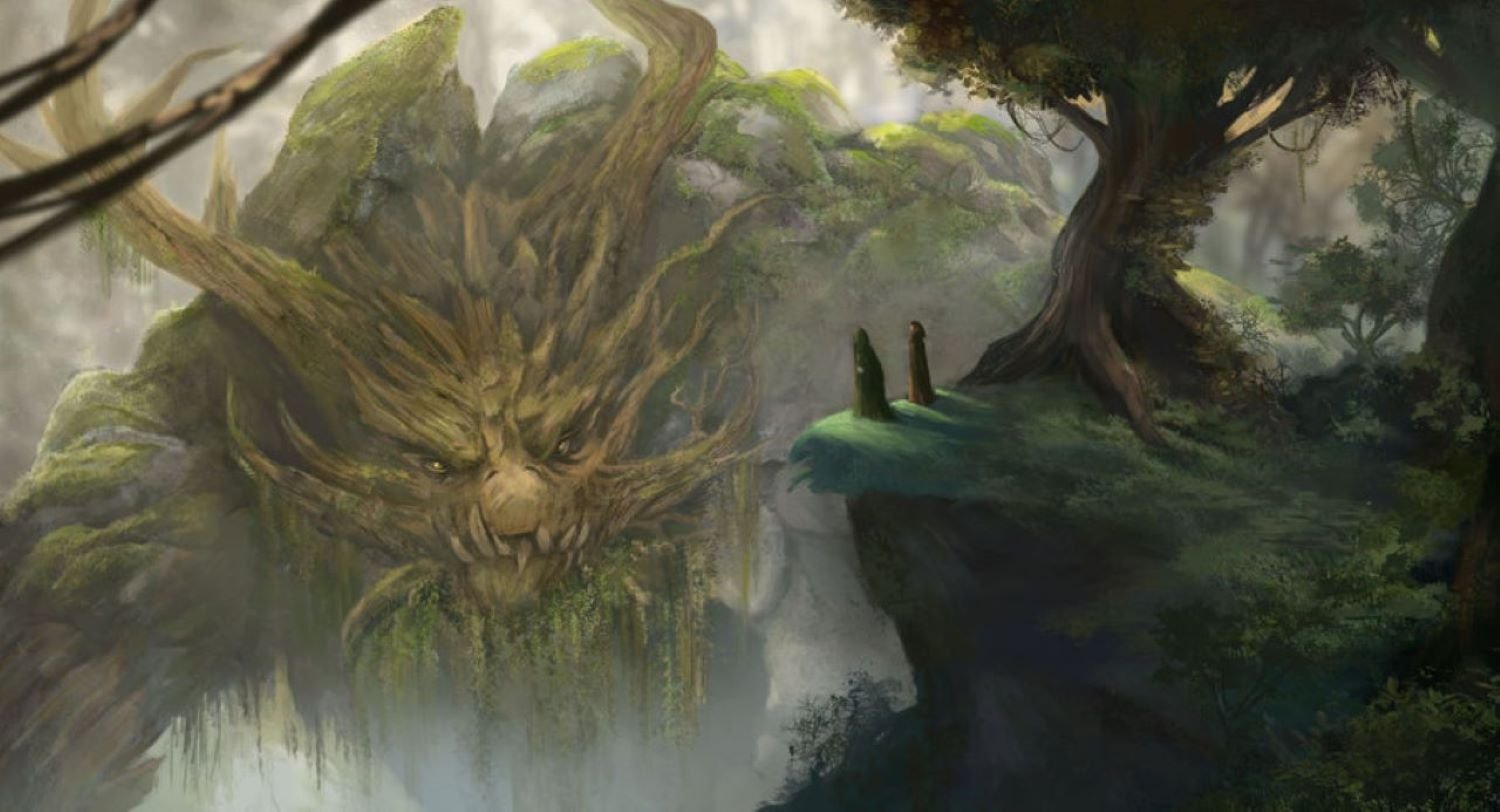
Mist stitched the chasm into a pale wound, and the forest leaned in to listen. From the cliffside rose a face older than weather—root and granite woven into a brow, a mouth lipped with moss, eyes like wet amber pondering the briefness of human breath. Two cloaked figures stood upon a tongue of earth that hung over the abyss, light pooling at their boots while the vast countenance regarded them without hurry.
“The covenant frays,” rumbled the living stone, its voice a rain of pebbles. “Rivers forget their songs. Cities feed on their own shadows.” The travelers did not bow; they unfastened their fear instead, and offered a seed wrapped in cloth the color of dawn. They had come to beg a path to the Heartwood, where memory still grows green, but the old guardian asked for a different toll: a promise made without proof. “A gate,” it said, “is a lesson in trust. It opens only to a step taken before it exists.”
Clouds thinned. Somewhere below, water struck hidden bells. The figures laced their hands, spoke their names into the wind, and let those names go. Roots stirred beneath the rim like serpents remembering they were bridges. Whether the earth would rise to meet them could not be known—and that was the point. The first heel lifted, and the world held its breath, for this was how every true journey begins: not with certainty, but with the courage to walk on what is not yet there. This is the story called Faith.
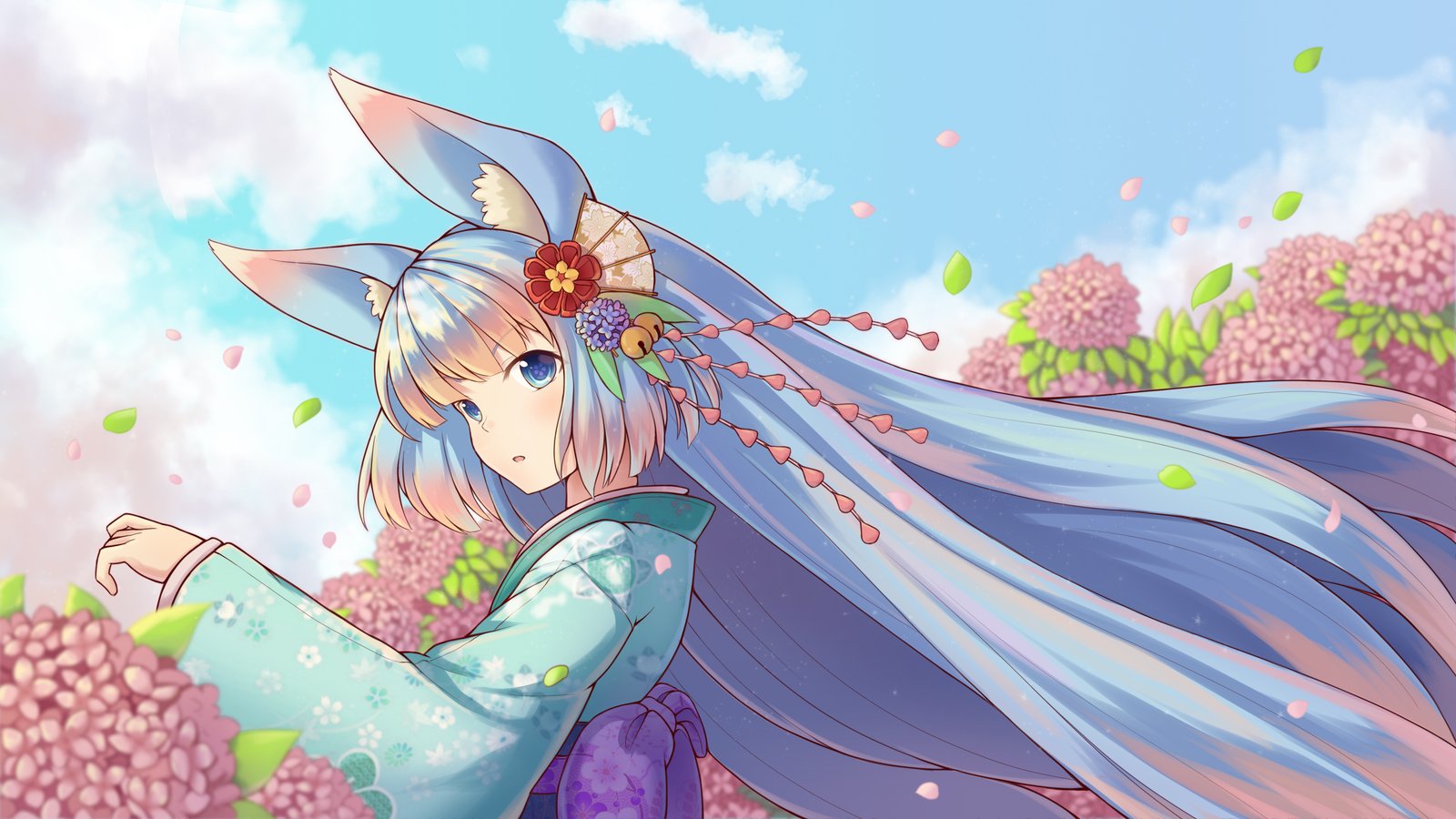
Pomegranate
The garden of hydrangeas breathed in shades of dawn, each clustered bloom a hush of secrets. Petals drifted like soft confetti around the girl in the sky-blue kimono, her long hair flowing with the wind as if it remembered rivers. Tucked near her ear—between soft, watchful ears of her own—hung a red blossom and a string of bead-like charms, the color of ripened seeds. They chimed when she moved, a quiet counting of choices yet to be made.
In this valley, the elders kept a story wrapped in silk: that the world is a pair of mirrored bowls, and the hinge between them is a fruit. Break the rind, bite a single shining seed, and the hinge turns; days spill into nights that never quite let go. She had grown listening to that whisper, fingers skimming petals that felt like cool rain, certain she would never taste what the story forbade. And yet the wind had begun to carry a different scent—sweet, mineral, the red of memory and promise.
When she reached into the blooms that morning, something small and heavy slid into her palm: a pomegranate where no tree grew, its skin veined like lightning under lacquer. The bead-charms at her temple stilled, the sky held its breath, and even the leaves forgot to rustle. One seed, the old tale said, binds you to the hinge; one seed turns a path into a threshold. She looked toward the far hills and then at the fruit, and the garden waited to learn whether summer would remain a guest—or become a vow.
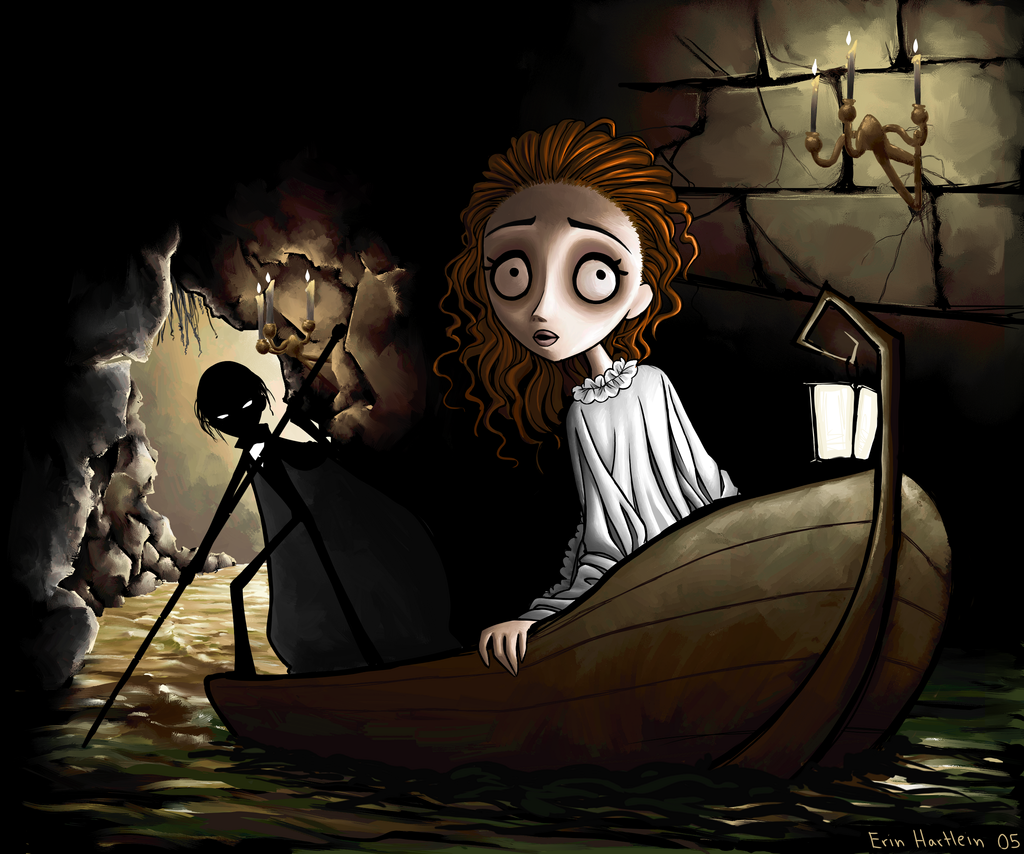
Is this the end?
Candles clawed small halos from the sweating stone as the little boat slid along the throat of the earth. The girl in the white nightdress kept one hand on the gunwale and the other on her breath, eyes wide as coins. Behind her, a ferryman made of shadow worked the pole in steady strokes, each push sketching ripples the color of old brass. A lantern shaped like an open book swung from the prow, its pale pages trembling with every hollow echo.
She had come down through a door that shouldn’t exist and a stair that felt older than regret. “Is this the end?” she asked, but the only answer was the hush of water and a voice like damp parchment: “It is where endings meet themselves.” The wall beside them split with hairline cracks that leaked a wick of light, and the candles ahead burned low, as if time itself were running out of tallow.
They floated past the last remembered turn, where the ceiling wept and the river learned her name. Behind her, the world she knew pinched shut like a wound; before her, the tunnel widened into a mouth of dusk. The boat kissed a shore she could not yet see, and while the lantern’s pages fluttered in a breathless draft, she understood that some doors only open from the inside—especially the ones everyone mistakes for an end.
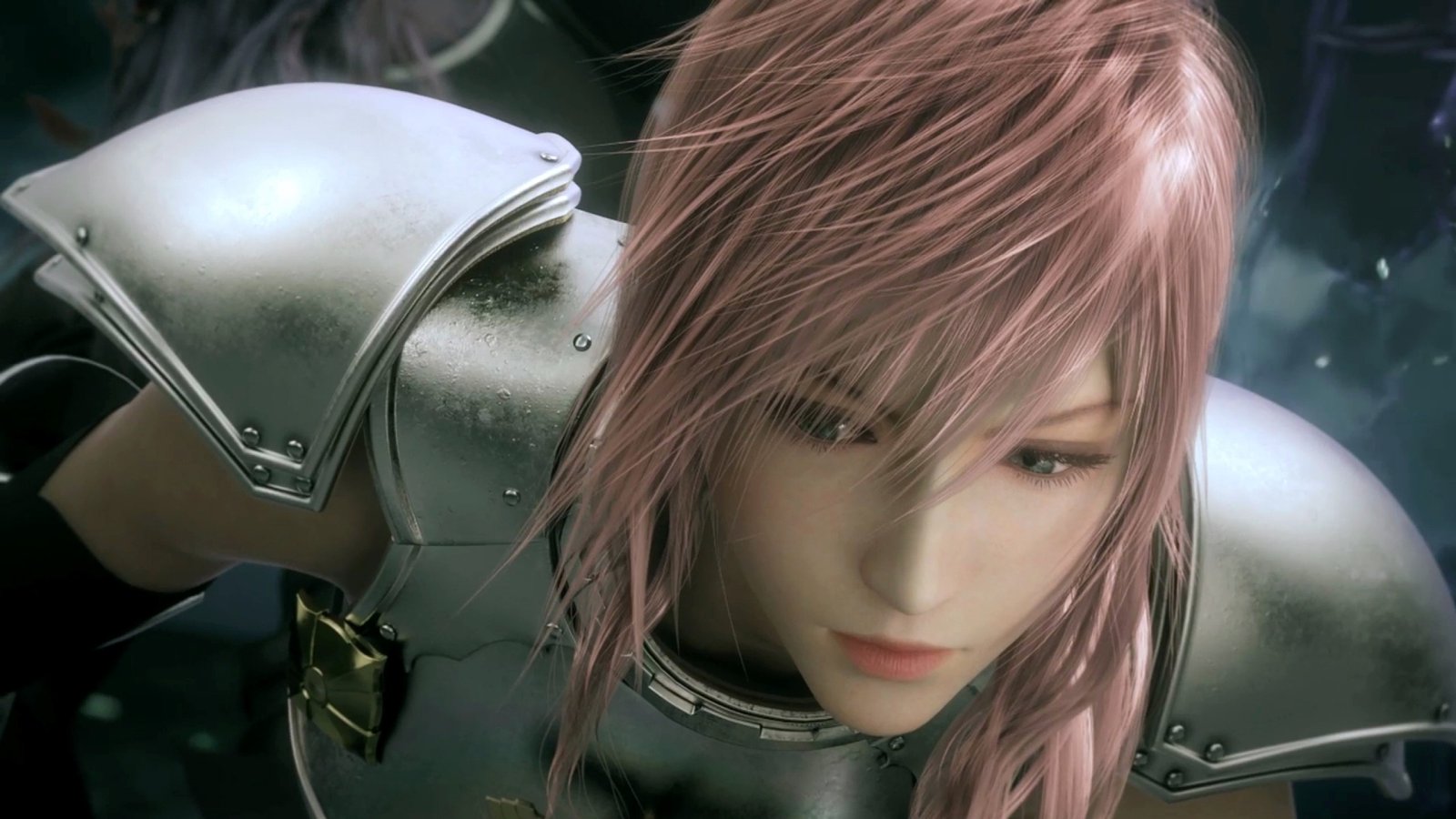
Heartbreak
The night pressed close, smelling of rain and iron. She crouched beneath it, silver plates scuffed and starred with old impacts, pink strands of hair clinging to the curve of her cheek. In the shallow of her breath lived a silence too sharp to touch, the kind that follows when a name is spoken once too often to the dark and the dark gives nothing back. Around her, the world held its breath with her, as if frost itself were waiting to hear what she would choose.
Once, she had been a blade for other people’s stories—clean, bright, unbreakable. But the last battle left no song, only a threadbare ribbon tied inside her chest where someone used to be. Rumor says he fell; memory argues he promised. Between them lies the road she dreads most: the one that walks through questions with no answers, through allies who look like shadows and enemies who look like mirrors.
She stands. Armor settles, a soft thunder across her shoulders, and the sky splits a seam of pale dawn over the horizon. If love is a wound, then let it be a compass; if grief is a chain, then let it pull her to truth. She will follow the ache wherever it leads, across the cold, across the clamor, until the silence finally speaks or the heart that breaks becomes the one that remakes.
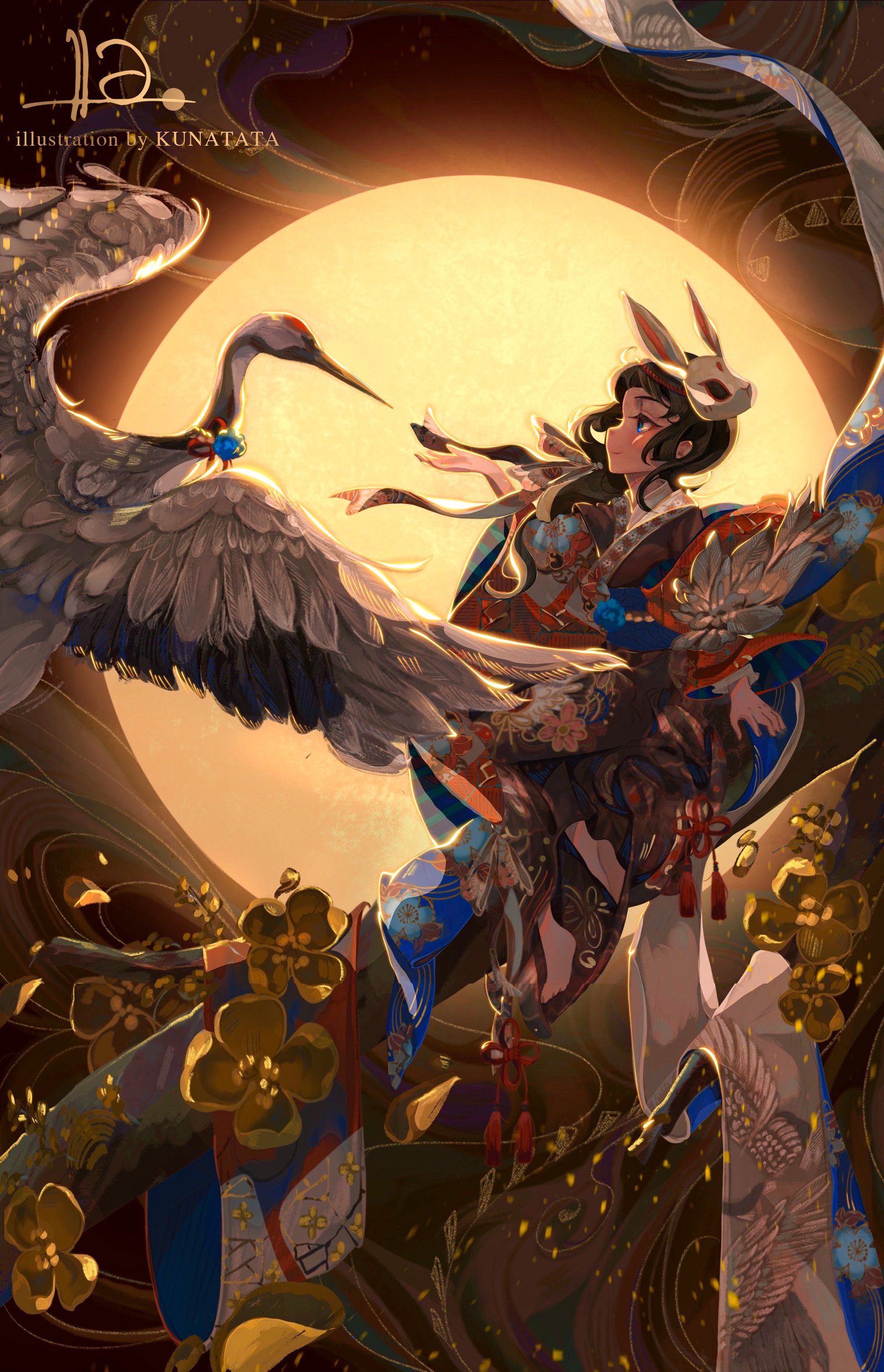
Speed
On the night the moon swelled like a great golden drum, the roads of air unspooled from its rim and the messenger of the hare was called to run them. Silk and feather stitched the wind into ribbons around her, and a crane with bell-bright eyes lowered its neck in greeting. Flowers rose from the dark like sparks, caught in the hush before a heartbeat, waiting for her to decide which way the world would turn.
Speed, to her, was not motion but permission: the right to pass between seconds without being seen. In that narrow country, petals did not fall and arrows never landed; oaths hovered, tasting of cinnamon and salt. Her mask kept her true, her kimono carried maps of forgotten currents, and the crane’s wings beat the measure of time itself. Together they were a question whispered to the night: how fast must one move to keep sorrow from arriving?
Tonight, a name had been stolen from the river of hours, and the current had begun to clot. If she did not deliver its echo to the sun’s threshold before dawn, morning would arrive with a limp, and the day would never learn to run. The crane bowed once, the moon rang once, and she stepped forward—cutting the dark with a blade of bright silence—chasing the only thing that can outrun loss: speed itself.
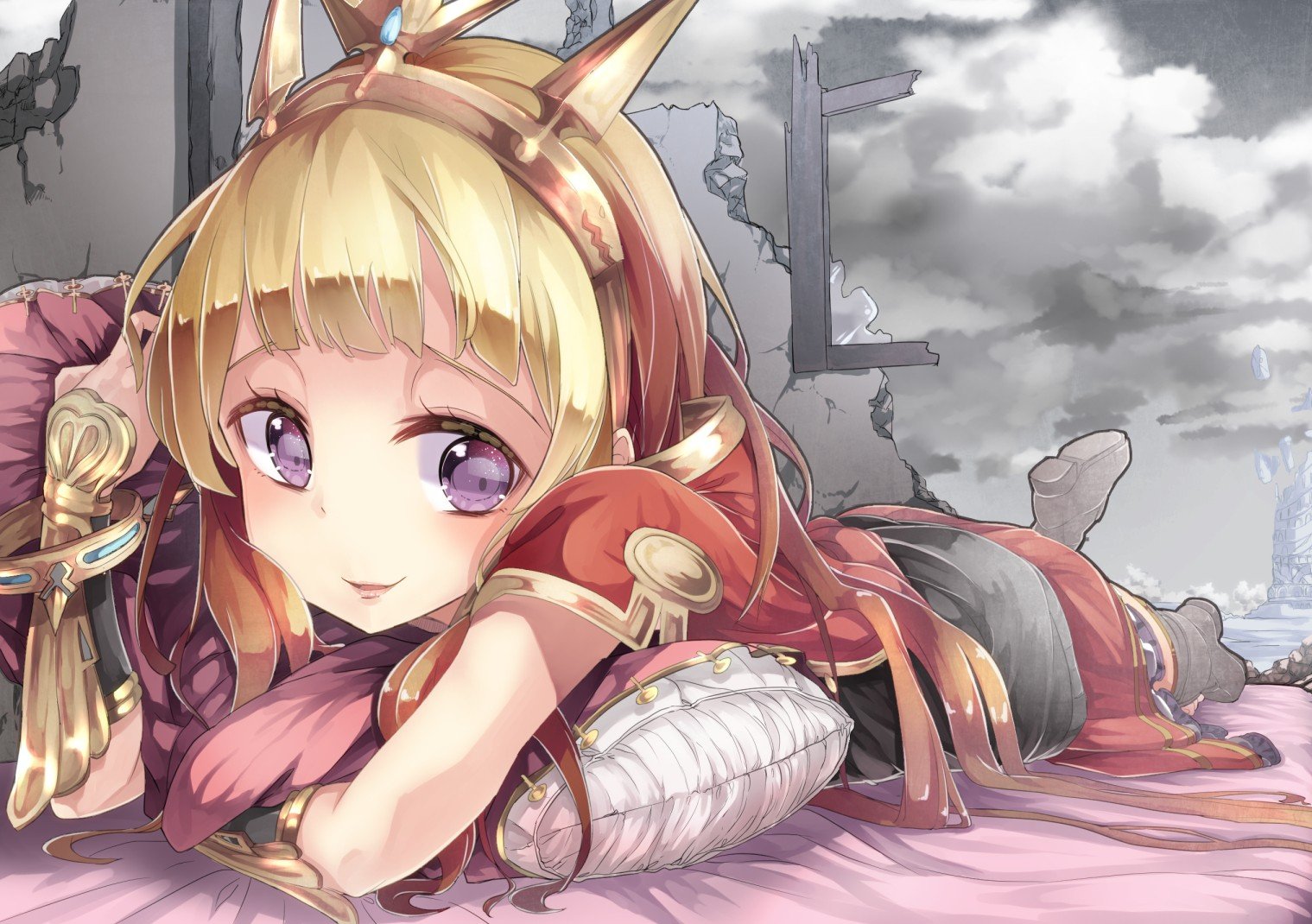
Loneliness
The day the kingdom fell quiet, its last light did not go out; it lay down. She lingers among the ribs of ruined halls, an ember in scarlet and gold, her small crown catching the gray like a stubborn star. The sky is ash and ocean together, the wind a patient tailor hemming the edges of silence. On a pink scrap of comfort, she props her cheek and listens to the distant crumble of yesterday, as if the stones might finally tell her why they let go.
She has learned the art of stillness the way others learned swordplay. In her violet eyes, the world arrives twice—once as it is, and once as it might have been—both glimmering, both out of reach. The air smells of rain that has forgotten its name. Ribbons breathe around her like slow flames, and the ornaments on her wrists weigh less than the stories no one remained to finish.
If you have come this far, step softly. Bring a rumor of warmth, a thread of laughter, any small mercy that can be sewn into a future. The ruins remember, but granite is a poor storyteller; it needs a voice. She will rise when the silence grows heavy enough to lift, when a new footfall breaks the habit of ghosts. Until then, she keeps her vigil—lonely as a lighthouse, and just as stubborn—guarding what little light refuses to leave.
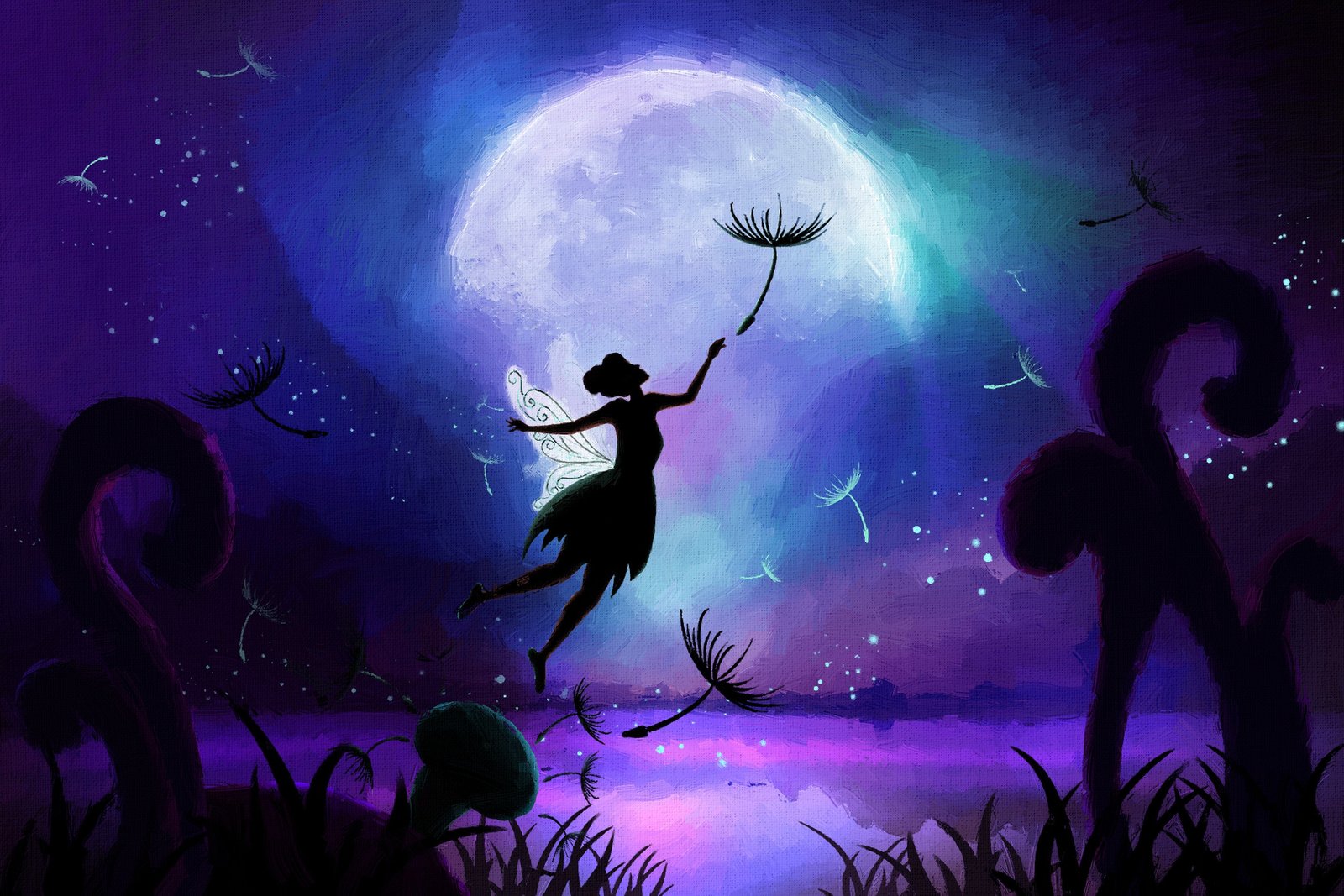
Happiness
The moon hung like a great lantern above the violet lake, and the night breathed dandelion stars. A small winged girl rose on the wind, a single seed between her fingers, her silhouette inked against the glow. The reeds bowed, the mushrooms listened, and even the curled ferns uncoiled to watch her lift into the hush that makes wishes audible.
She was called a Keeper of Small Joys, one of the few who could hear laughter before it was born. On this night the world felt strangely hollow, as if someone had swept the smile from its surface and left only the shine. The seed she carried was the last unspent wish of the season, the only bright fleck that hadn’t drifted into sleep; within its feathery crown chimed a tiny bell that rang for all the happiness forgotten, mislaid, or traded for noise.
With the lake at her heels and the moon at her shoulder, she vowed to follow the scatter of seeds across the dark—into homes where shutters creaked and into hearts that had learned to speak in sighs. She would find the first laugh again, the one that taught the world to lift its chin to light, and carry it back like dawn cupped in both hands. Until then, the night held its breath, and the wind kept all the secrets she would need to begin.
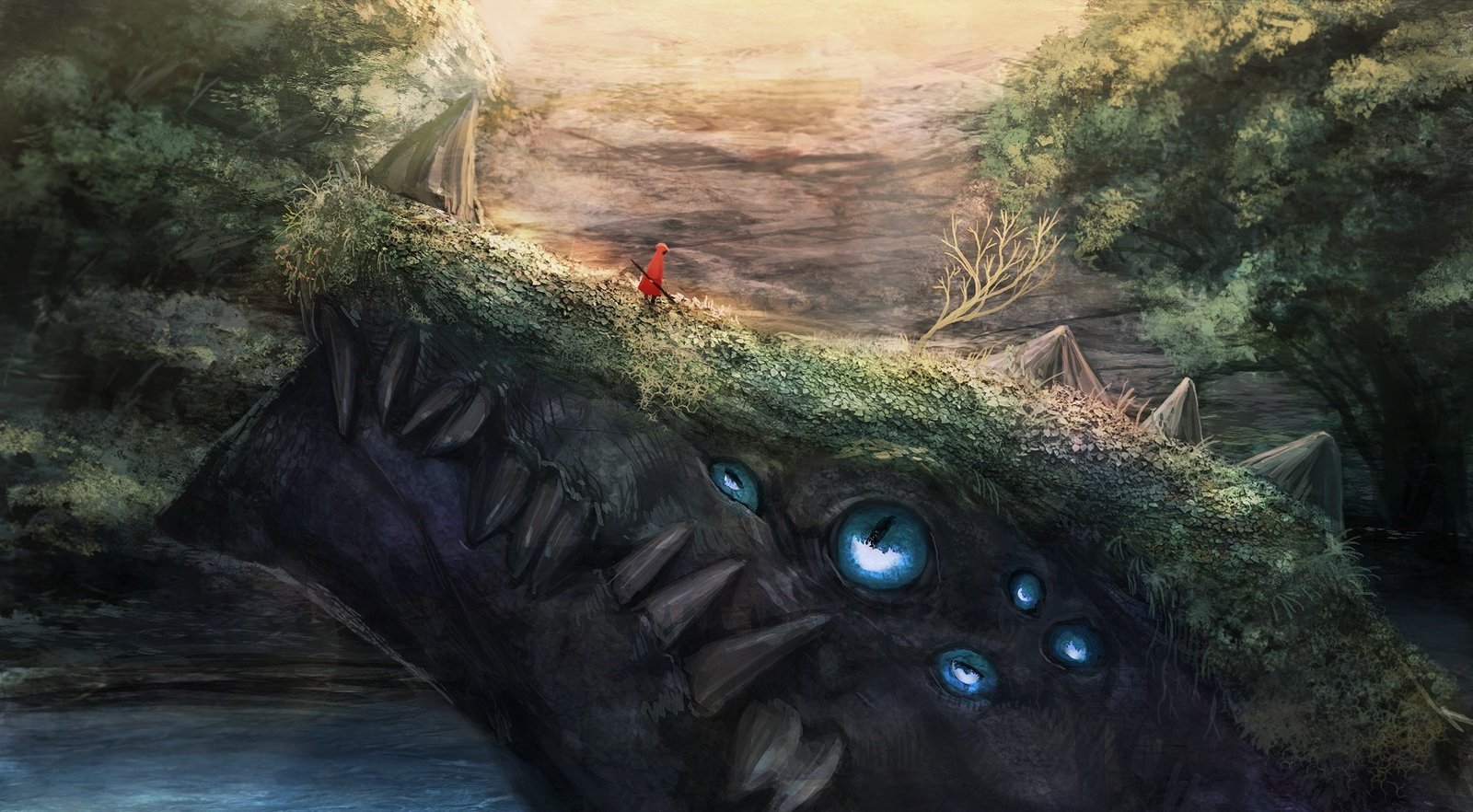
Change
Morning poured like pale honey across a ravine where trees leaned as if listening. A solitary figure in a red cloak walked the crest, boots whispering through lichen and tiny flowers, and the earth beneath them stared back with many blue eyes. What the maps called a ridge was the skull of something immense, less buried than patient, its teeth grown wild as shale and its breath disguised as river fog.
Stories said the old world fell asleep to survive its children. The figure had grown inside those stories like a seed in a lantern, warmed by a promise: when the time was right, a single step would be enough to tip the season. Steel at their hip answered the pulse beneath the moss; a scaled lid flexed, reflecting a winged shadow spiraling in the iris—perhaps a memory, perhaps a messenger. The creature did not rise. It waited, and the forest hushed around the choice.
Change, in the end, is a path you do not realize is a mouth until you are already walking it. The traveler kept moving, and the monster-mountain watched, and with each footfall leaf, tooth, and eye remembered what it meant to turn. Somewhere ahead the light gathered like a gate. Somewhere below, the old heart found its beat. And the world, no longer still, prepared to open.
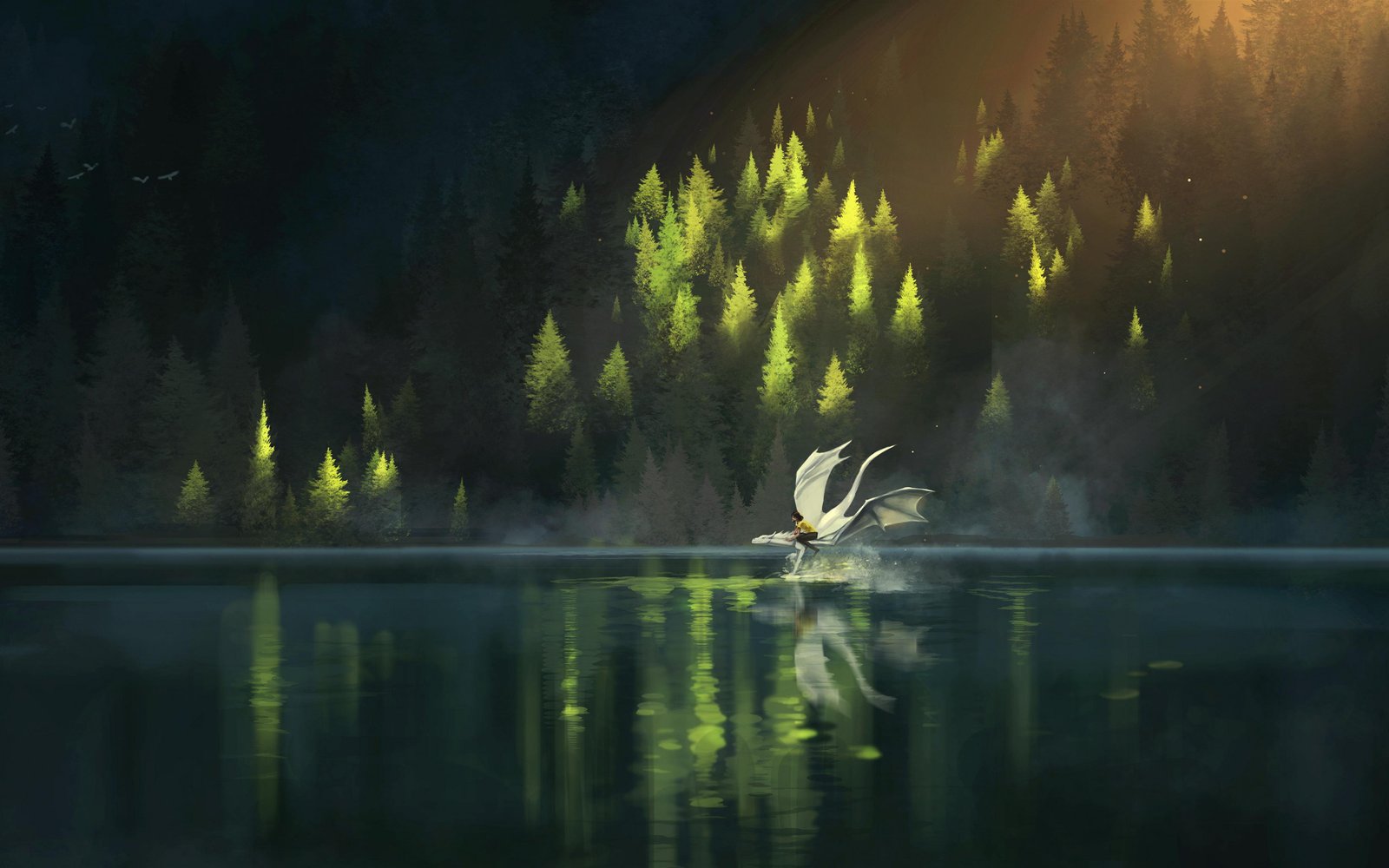
Love
At the hour when the forest loosens its night-long hush, a pale dragon skims a mirror-lake, scattering gold where the first light touches water. Pines rise like quiet witnesses, their crowns aflame with dawn, while mist unspools from the shore as if the world were exhaling. On the dragon’s neck a rider leans forward, hands in the small hollows between silver scales, body and breath tuned to the same rhythm as the beating wings. Their reflection travels with them—a bright ripple of what might be—before the lake seals it away.
They did not find each other by accident. Names were traded beneath a fallen star, and a vow was stitched between heartbeat and wingbeat: not the tether of reins and command, but the braiding of fears, flaws, and the quiet, stubborn courage to be seen. In a land where charters outlaw such bonds and hunters read affection as weakness, they call it by its sharpest, truest shape. Love—an edge and a shelter—guides them across the water’s skin, asking no promises but the ones they can keep.
Beyond the treeline the world is waking to their choice. Bells will carry, fires will answer, and old oaths will stir like sleeping thorns. Yet for a breath, this is all they are: pulse to pulse, light to wing, a beginning delicate as mist. The rings spreading from the dragon’s touch travel outward, striking shores they cannot yet see—messengers to friend and foe alike—announcing that something forbidden has learned to fly, and will not be landing soon.
Sad
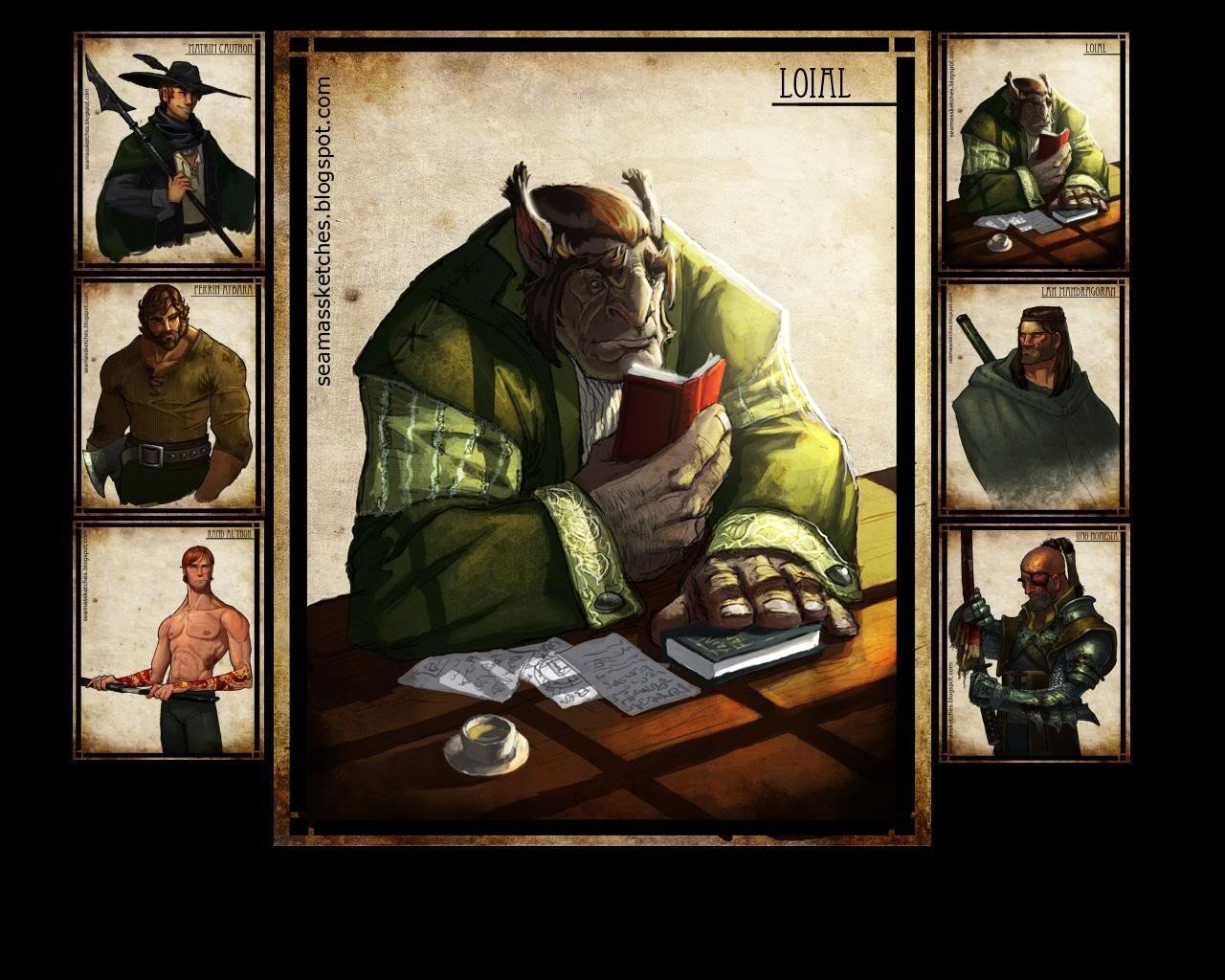
The candle guttered low, a small moon drowning in its own sea of wax, while the great scholar bent over his notes. His coat was the color of old forests, his hands large enough to shelter a teacup, yet gentle enough to turn a page without bruising it. Around him, portraits hovered like quiet constellations—faces of spear-bearers and swordsmen, hunters and wanderers—each frame a door he could no longer open. He read, he underlined, he crossed out a kindness and replaced it with truth. Sadness, he decided, was not an ending. It was the ink that made memories legible.
They had laughed once, the seven of them, and the room had felt less like a room and more like a hearth. Now it was a museum curated by longing. He wrote their names and the pages trembled: the sentinel with the raven-plumed hat, the scarred smith whose hands could coax iron into mercy, the red-marked duelist who fought like a poem torn in half, the hooded ranger who spoke in weather, the masked knight who hid his gentleness in steel, and the scholar himself—Loial—whose task had always been to remember. He pressed his palm to the parchment, as though the heat from his skin could warm what history leaves cold.
Outside, night tapped lightly at the shutters, asking to be let in. The book on the table wanted a final chapter; the world, beyond the lamplight, waited with its patient cruelty. Loial closed his journal and felt the weight of it settle into his bones. If the story was to move again, it would have to walk on his feet. He gathered the scattered letters, tucked them close to his heart, and stood—sad, yes, but steady—ready to search for the missing lines in the dark.
Dance
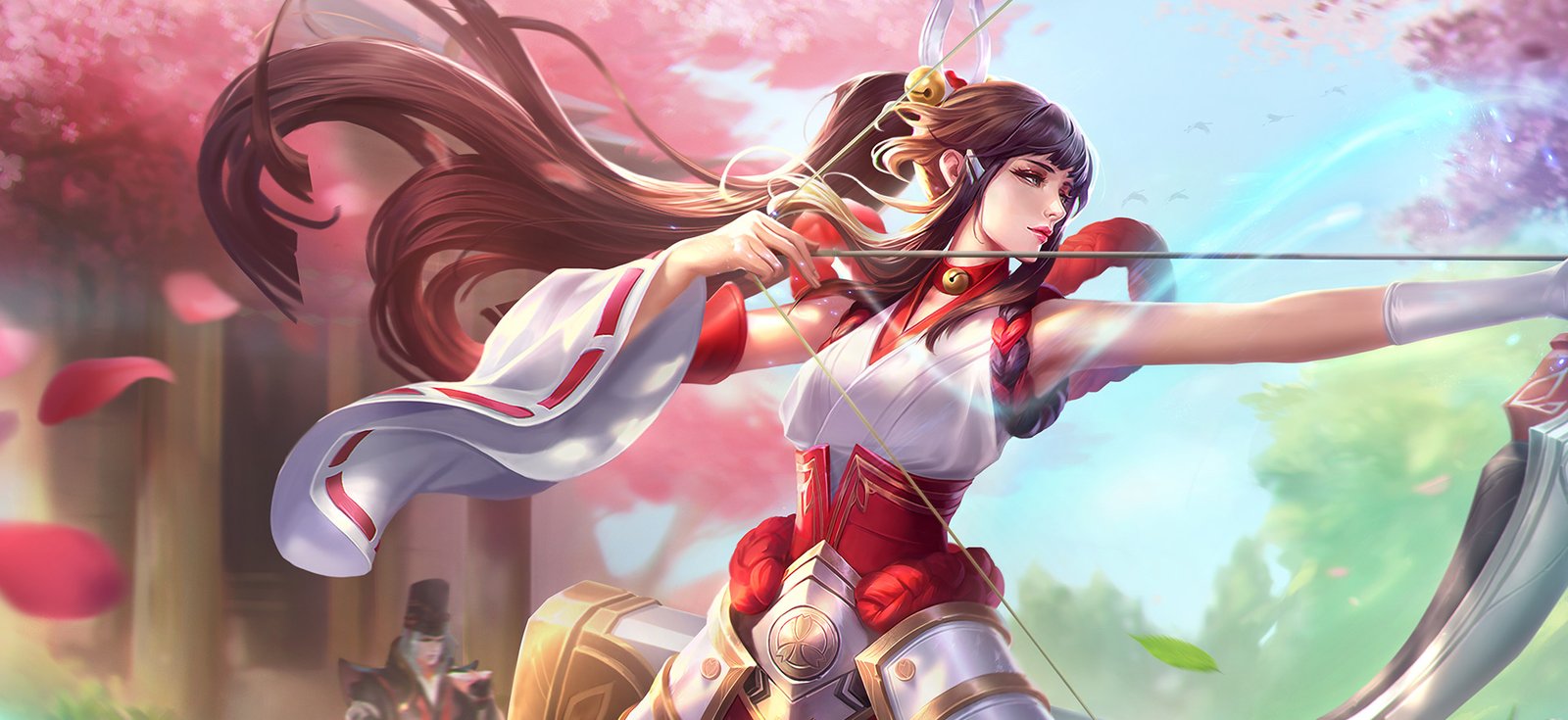
Petals fell like softened embers, turning the shrine courtyard into a stage. She stepped into it with a bow for a partner, hair and silk answering the spring wind. The string thrummed a single, silver note—one that gathered the scattered light, the drifting red leaves, and the quiet breath between heartbeat and release.
They had taught her that war is only clumsy when you forget the rhythm. In the mountain school, each stance was a measure, each draw a held note, and every arrow a step named after rain, after thunder, after dawn. Somewhere behind the columns, an attendant kept time in hushed taps, and the old gods, if they still listened, leaned closer for the chorus.
Now the world waited at the edge of that perfect pause. The first arrow would trace the opening figure, stitching a path through bloom and sky; the second would answer with a turn; the third would set the night in motion. When she exhaled, the petals rose with her, and the Dance began.
Escape
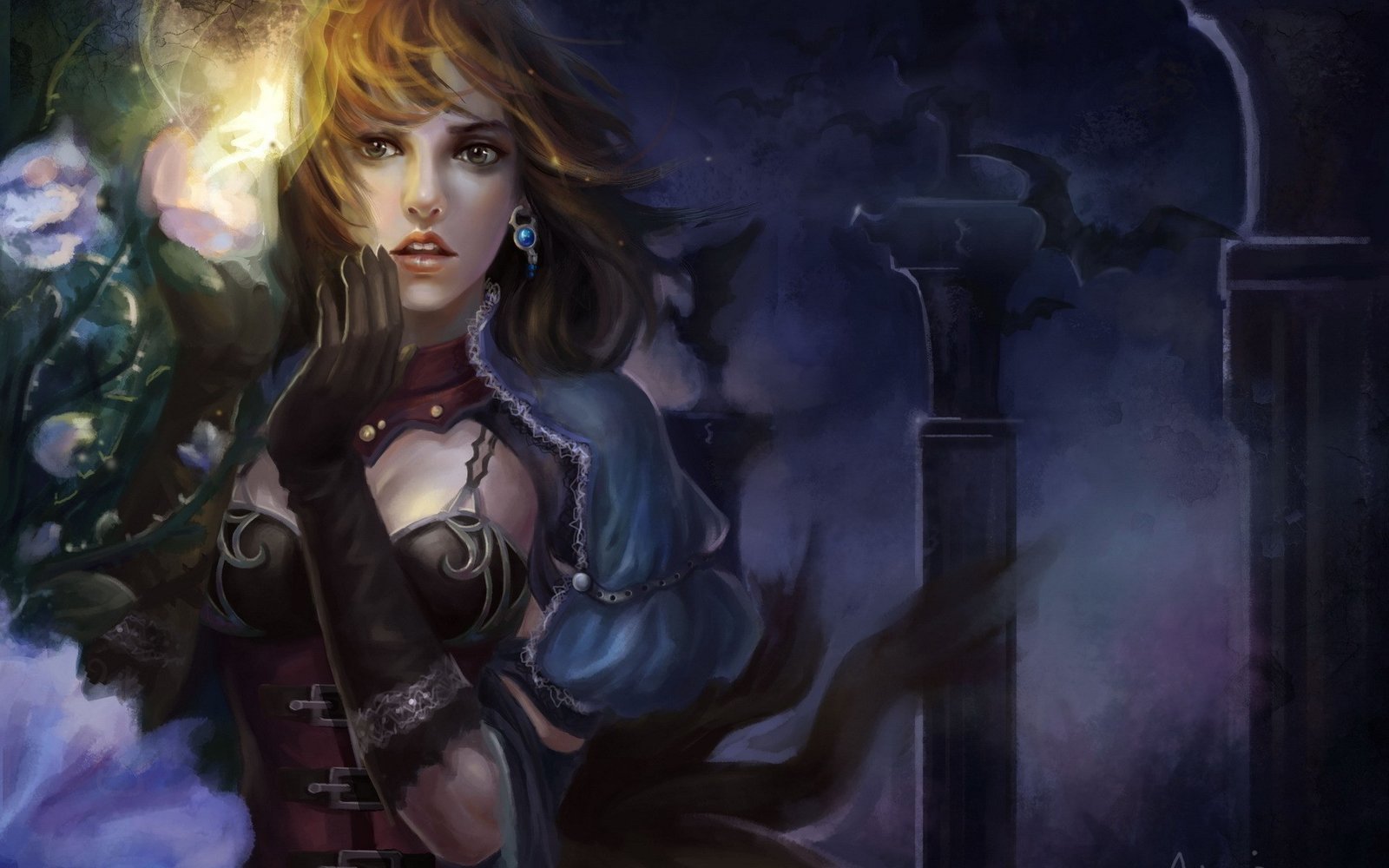
Night drapes itself over the crumbling colonnade, and the bats rise like torn pages, spelling warnings across the sky. She stands at the garden’s edge, wind lifting her hair into a banner of gold, a shard of light cupped in her gloved hand. The roses here bloom in moon-pale spirals, their thorns lettered with old vows, and the stone behind her—those black-boned halls—still remembers the weight of her footsteps. The little light trembles, eager, as if it too longs to run.
Locks were never her prison; promises were. They buckled her like the clasps at her waist, stitched tight as lace at her sleeves, and the house fed on those stitches, kept its wards and watchers circling. But tonight the wards blink. The watchers miscount. With the blue flicker of a charm at her ear and the quick prayer of a breath, she parts the hedge of memories, brushing past flowers that refuse to scent the air for anyone else. The path ahead is thin as a thread and just as necessary.
She opens her palm and the light spills free, a moth-shaped ember drawing a doorway where shadow thought itself unbroken. Beyond it, the dark is not empty but wild with unheard music, and the first step is a blade between fear and longing. Behind her, the castle gathers its breath and misnames her, trying to call her back as it always has. Ahead, the night answers with a new word, a quiet invitation: run.